

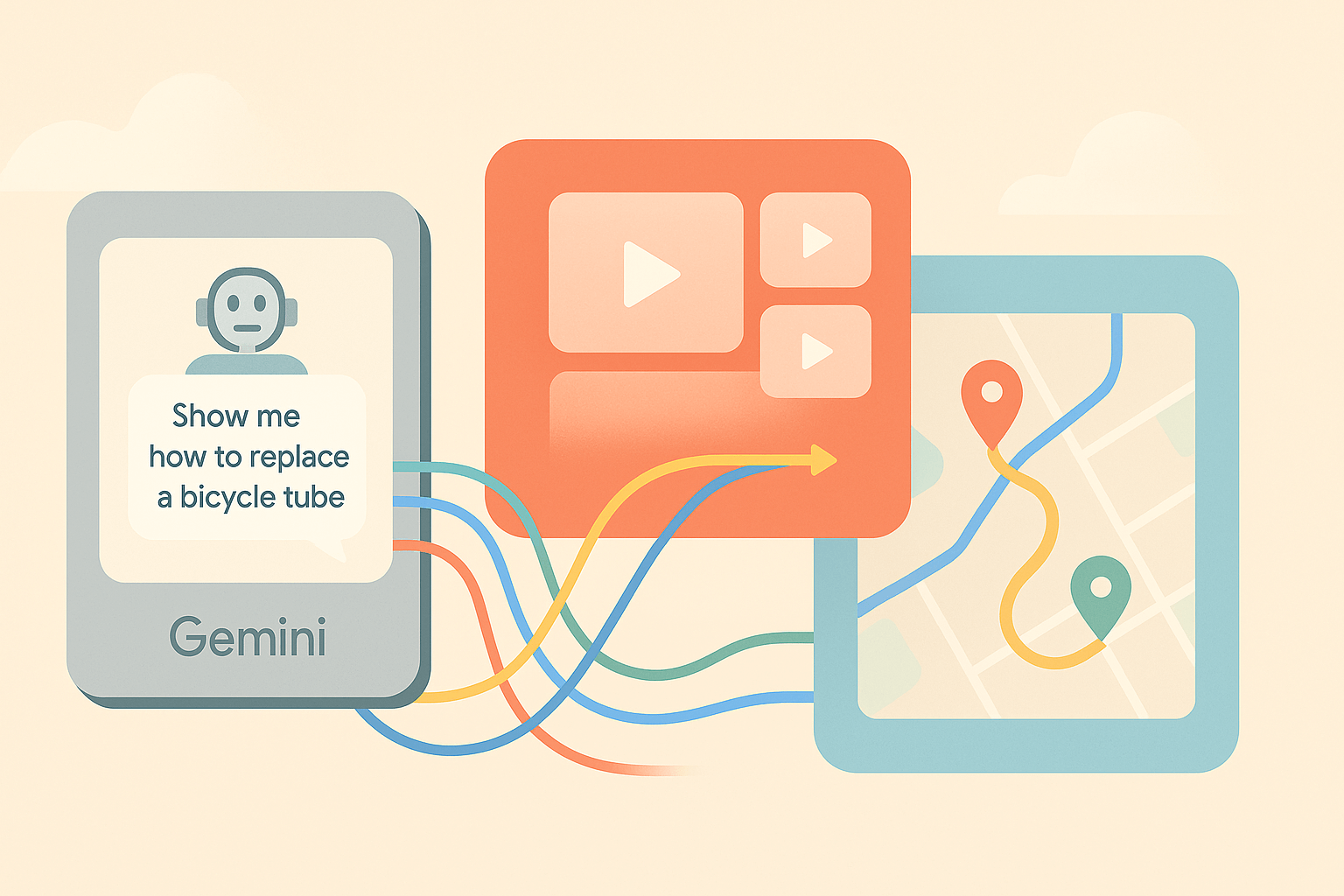
Google Gemini YouTube Maps integration is now live: Google removed the old “@YouTube/@Google Maps” triggers, so plain-language prompts route to YouTube and Maps automatically. As of October 2025, users no longer need to use specific commands like “@YouTube” or “@Google Maps” to access these services within Gemini. This update allows natural-language queries to automatically route to the appropriate service, marking a shift toward a more intuitive and cohesive user experience.
Coupled with Gemini’s deeper integration into Chrome and Google Home devices, as well as its use of public data from YouTube and Maps, this change reflects Google’s ambition to position Gemini as the central interface for its sprawling product suite.
This article explores the details of this update, its technical and strategic implications, and its potential impact on users, businesses, and the broader technology landscape. By examining how Gemini’s new capabilities work, why they matter, and the regulatory context surrounding them, we aim to provide a comprehensive understanding of Google’s latest move in the AI-driven assistant space.
What the Google Gemini YouTube Maps integration changed
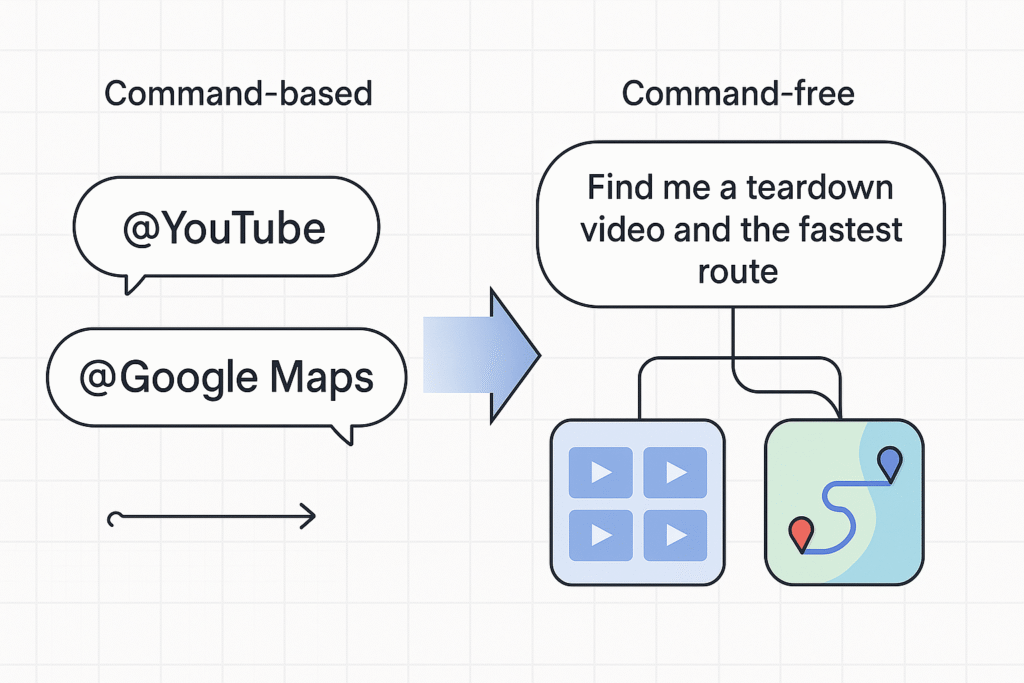
The Google Gemini YouTube Maps integration eliminates explicit @commands and lets Gemini infer intent for video and navigation tasks. Previously, users had to prepend queries with “@YouTube” or “@Google Maps” to direct requests to these services, a remnant of Gemini’s earlier “apps/extensions” framework.
Now, users can say, “show me repair videos for my bicycle” or “find the fastest route to MLE with a coffee stop,” and Gemini intelligently routes the query to the relevant service. This change, confirmed by users, removes the standalone “@YouTube” and “@Google Maps” extensions, making interactions more fluid.
The update is part of a broader push to embed Gemini deeply into Google’s ecosystem. Over the past month, Google has integrated Gemini into Chrome, enabling it to perform actions across websites, such as filling out forms or navigating pages. Additionally, Google is preparing to replace Assistant with “Gemini for Home” on smart displays and speakers, signalling a shift toward a unified AI-driven interface. This integration allows Gemini to serve as a single-entry point for multiple Google services, reducing friction for users.
On October 13, 2025, Google introduced another key change: Gemini now automatically incorporates public data from YouTube, Google Maps, Flights, and Hotels to enrich its responses.
For example, a query about a local business might pull in hours or reviews from Maps, while a request for tutorials might leverage YouTube’s public video data. Users can opt out or manage data usage through account controls, ensuring some level of privacy customization.
This policy shift enables Google Gemini’s command-free routing by providing the data backbone needed to interpret and fulfil user intents through YouTube integration and google maps integration
How the Updated Google Gemini Works
The updated Google Gemini system is designed to interpret natural-language queries and route them to the appropriate service without explicit user direction. Here’s how it functions in practice:
YouTube Queries
A user might ask, “show me the best teardown videos for Trina 690W Vertex N.” Gemini recognizes the intent as video-related and delivers a YouTube-flavoured response, such as video thumbnails or curated playlists, without requiring the “@YouTube” command. This seamless access to YouTube content reduces the cognitive load on users.
Google Maps Queries
For navigation requests like “fastest route to Velana Airport with a coffee stop near Hulhumalé by 7:45,” Gemini leverages Maps data to provide turn-by-turn directions and suggest relevant points of interest, such as nearby coffee shops. The response is presented in a conversational format, blending Maps functionality into the interaction.
Conversational Follow-Ups:
On platforms like Gemini Live or Google Home, users can engage in back-and-forth conversations that draw on Maps data, such as business hours or popular times, to refine suggestions. For instance, asking, “Is that coffee shop open now?” Prompts Gemini to check real-time Maps data and respond accordingly. [Google Support]
This command-free approach relies on Gemini’s improved natural language processing and its ability to access public data from Google’s services. By eliminating the need for specific prefixes, Google has made Gemini more accessible to casual users who may not be familiar with its previous syntax.
Why Google Gemini Updates Matters
For everyday users, this update removes barriers to accessing Google’s services. No longer needing to remember specific commands like “@YouTube” or “@Google Maps” means fewer errors and a more intuitive experience. Users can focus on their intent—whether finding a video or getting directions—without worrying about the underlying mechanics.
This aligns with Google’s long-standing vision of an assistant that resolves user intent seamlessly, a promise dating back to the introduction of Google Assistant in 2016.
For businesses, the Google Gemini YouTube Maps integration means more queries that implicitly pull from Google Business Profile data.
Complete listings with current hours, product inventory, photos, and reviews are more likely to be surfaced by Gemini, while incomplete profiles risk being overlooked. This shift underscores the importance of maintaining a robust online presence within Google’s ecosystem.
From a strategic perspective, the integration positions Gemini as the “glue” for Google’s platform. By embedding Gemini into Chrome, Google Home, and now YouTube and Maps, Google is moving toward a future where the Assistant serves as the primary interface for its services.
This consolidation could streamline user interactions across devices and platforms, making Google’s ecosystem more cohesive and competitive against rivals like Amazon’s Alexa or Apple’s Siri.
Regulatory Context
Google’s integration of Gemini with YouTube and Maps has not gone unnoticed by regulators. In ongoing U.S. remedies talks, Google has defended its right to bundle Gemini with its services, arguing that such integration is standard for nascent AI markets.
However, critics contend that bundling could raise anti-competitive concerns, particularly given Google’s dominance in search, mapping, and video platforms. The command-free routing, while user-friendly, may be cited in regulatory debates as evidence of Google’s efforts to tighten control over its ecosystem.
Looking Ahead
Google’s latest update to Gemini reflects a broader trend in AI development: the move toward invisible, intent-driven interfaces. By removing the need for explicit commands and leveraging public data, Google is making Gemini a more natural extension of its services.
As Gemini expands, the Google Gemini YouTube Maps integration will shape how users find videos and navigate—without thinking about which app to open. This could set a precedent for other tech giants racing to unify their ecosystems under AI-driven assistants.
For users, the change means a more straightforward, more conversational way to interact with YouTube and Google Maps. For businesses, it’s a reminder to prioritise their Google Business Profiles to stay visible in an AI-driven world. And for Google, it’s a step toward realising its vision of an assistant that not only understands user needs but also seamlessly connects them to the right tools.
As Gemini continues to evolve, its role as the central hub of Google’s ecosystem will likely grow, shaping the future of how users navigate the digital world.