

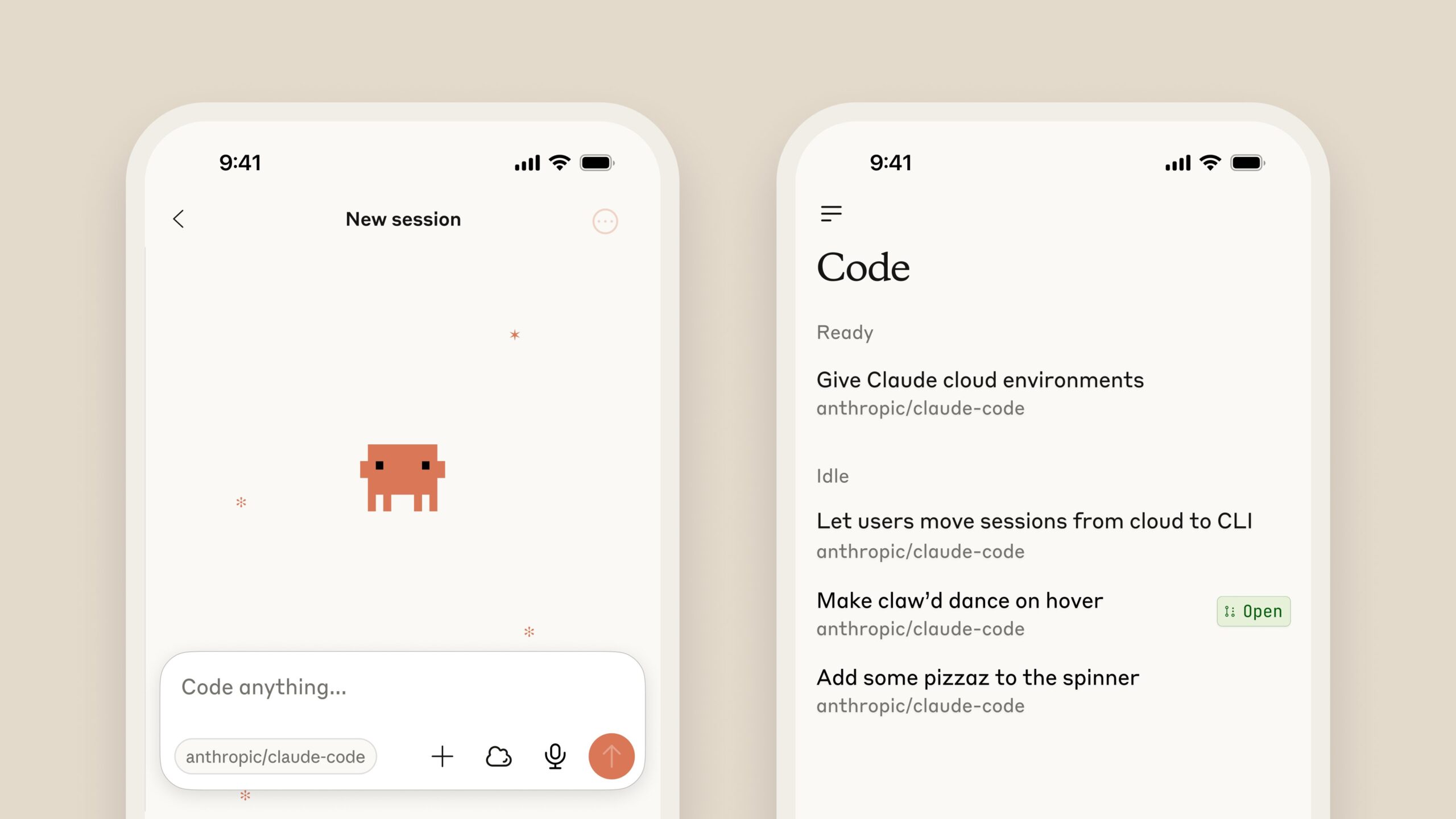
Claude Code web moves Anthropic’s coding agent from the terminal into a browser tab, letting you connect GitHub repositories, run tasks in a sandbox, and receive work as branches and PR.
The announcement was teased on X by the official Claude account and backed by a dedicated launch page on Anthropic’s site. In practical terms, this means you can now delegate coding tasks—such as bug fixes, feature scaffolds, and refactors—directly from a web UI that communicates with your GitHub repositories, returning work as branches and pull requests.
This web launch matters for two reasons. First, it removes the friction of installing and learning a CLI, making agentic coding accessible to a wider audience.
Second, it aligns with Anthropic’s broader push to put Claude wherever work happens—web, mobile, and terminal—so developers and product folks can involve the agent without context-switching. Media coverage underscores that shift, noting access via browsers and the iOS app, with the web edition framed as a significant step toward mainstream agentic workflows.
What’s new in Claude Code web?
- Code tab on claude.ai (research preview): Start coding sessions from the browser; describe what you need and have Claude implement it.
- GitHub integration: Auth to selected repos, branches, PR creation—review diffs before merge.
- Parallel tasks: Multiple coding jobs can run concurrently, each in an isolated environment, allowing you to steer progress mid-flight.
- Sandboxed execution & security options: New sandboxed bash tooling and allow-listed network access aim to improve safety and transparency while the agent executes steps.
- Availability: Research preview for Pro and Max users today; Team/Enterprise premium seats are slated to follow.
External reports echo these points, calling the web app a notable expansion from the terminal-only tool and placing it in the context of a broader strategy to democratise agentic coding.
Why is Claude Code Web a big deal?
Agentic coding tools—systems that plan, execute, and revise code changes—are crossing a usability chasm. Historically, tools like Claude Code demanded a terminal-first mindset and careful setup. The web interface narrows the gap between chat-based AI and “AI that ships code,” meeting teams where they already spend time: the browser and GitHub.
Independent commentary from developers who tested the preview highlights several practical wins, including picking a repo, selecting an execution environment (from locked-down to broader access), feeding a brief spec, and letting Claude branch and draft a PR—while you queue follow-ups that run after the current step completes. That event-loop feel is exactly what agents needed to be useful in real project life.
How it works (high level)
- Connect a repo. In the new Code tab, authenticate to GitHub and choose the repositories you want Claude to work in.
- Describe the task. Provide a natural-language brief—”migrate auth middleware to NextAuth vX,” “add dark mode toggle,” “fix flaky unit tests,” etc. Claude builds a plan.
- Execute in a sandbox. Claude runs commands in an isolated environment. Anthropic’s new sandboxed bash tool backs this with stronger safety defaults and optional domain allow-lists.
- Iterate in real time. You can nudge direction as it works; additional prompts are queued and executed in order.
- Review changes. Results land as a branch (and optionally a PR) for you to review and merge.
For teams already experimenting with agents, Claude Code web is the practical step: describe a task, watch the plan unfold in an isolated environment, and review a GitHub PR before merging. The browser UI makes guardrails visible—sandboxed execution, optional allow-lists, and human-in-the-loop checkpoints—so you scale automation without sacrificing control.
Pricing and availability
The web app is included with Claude Pro and Claude Max during the research preview phase. Anthropic’s docs and support pages emphasise a unified subscription that covers Claude on the web/desktop/mobile and Claude Code in the terminal, with Team/Enterprise support queued next.
How it compares (briefly)
- Versus the terminal-only Claude Code: Same core agentic behaviour, but with lower setup friction and a UI to monitor/steer runs. The terminal remains available (and powerful) for developers who prefer it.
- Versus chatbots that “suggest code”: The web app leans into doing—executing commands, running tests, and returning PRs—rather than only generating snippets. That aligns with Anthropic’s recent model upgrades (e.g., Sonnet 4.5), tuned for tool use and multi-step reasoning.
- Versus ecosystem peers: Coverage points to a “work-where-you-are” approach similar to GitHub Copilot’s deep IDE presence and Cursor’s agentic flows, but here the browser becomes a first-class cockpit with multi-task orchestration and PR handoff.
Early signals from the field
The launch clearly widens the access to advanced coding agents—particularly for individuals and small teams who want automation without wrestling with local environments.
Some pieces go further, citing internal productivity claims and strong adoption since the public release of Claude Code earlier this year, while still stressing the human aspect.
Developers remain essential for specification, review, and system design.
Developer write-ups add texture to the UX: task prompts that enqueue while a step runs, isolated environments to reduce foot-guns, and tidy PRs you can scan and comment on.
These are the little touches that make agents feel like pragmatic collaborators rather than demo-ware, but some people, of course, have a different opinion.
What’s under the hood—and the guardrails
Anthropic’s engineering note pairs the web app with a sandboxed bash tool to constrain what the agent can do by default, and to make network/file access explicit.
That’s crucial for enterprise readiness, where governance demands auditability and least-privilege execution. The goal is to unlock automation while keeping a human in command of scope and blast radius.
Anthropic’s broader platform updates also matter here.
Skills—Anthropic’s new, composable add-ons that bundle instructions, scripts, and resources—are designed to travel across Claude experiences, including Claude Code. Expect Skills like “follow our brand code style” or “generate our standard integration test harness” to be reusable in both chat and code contexts.
Getting started (quick guide)
- Visit claude.ai/code and sign in with a Pro or Max account.
- Connect and authorise the GitHub repos you want Claude to work in.
- Choose your default environment (from fully locked-down to allow-listed access).
- Submit your first task, then review the resulting branch/PR before merging.
- These steps are outlined in Anthropic’s docs for the web app. Claude Docs
The bigger picture
The web edition of Claude Code marks a steady march from “AI that talks about code” to “AI that ships code under supervision.” As agentic models improve at planning, tool use, and safe execution, the bottleneck shifts from typing to spec quality and review quality.
If your team writes crisp briefs, documents decisions, and keeps tests meaningful, an agent like Claude Code can accelerate the boring parts and free humans for architecture, product choices, and taste.
There are still open questions—how these agents behave on messy monorepos, how they navigate conflicting architecture patterns across services, and how reliably they heed organisation-specific conventions without tripping on edge cases. But a browser-first cockpit with PR-native handoff is a pragmatic step that will put agentic workflows in front of a lot more people, a lot faster.
FAQs
What is Claude Code on the web ?
It’s a browser-based interface for Anthropic’s agentic coding tool, letting you run tasks, create branches/PRs on GitHub, and review diffs without a terminal.
Who can access it today?
Pro and Max subscribers during the research-preview phase, with Team/Enterprise support slated to follow.
How is it different from chatbots that only suggest code?
Claude Code executes steps in a sandbox, runs commands/tests, and returns GitHub branches/PRs—so it delivers working changes, not just snippets.
Is it safe to run in my repo?
It uses sandboxed execution and explicit allow-lists. You still review every change as a branch/PR before merging.