


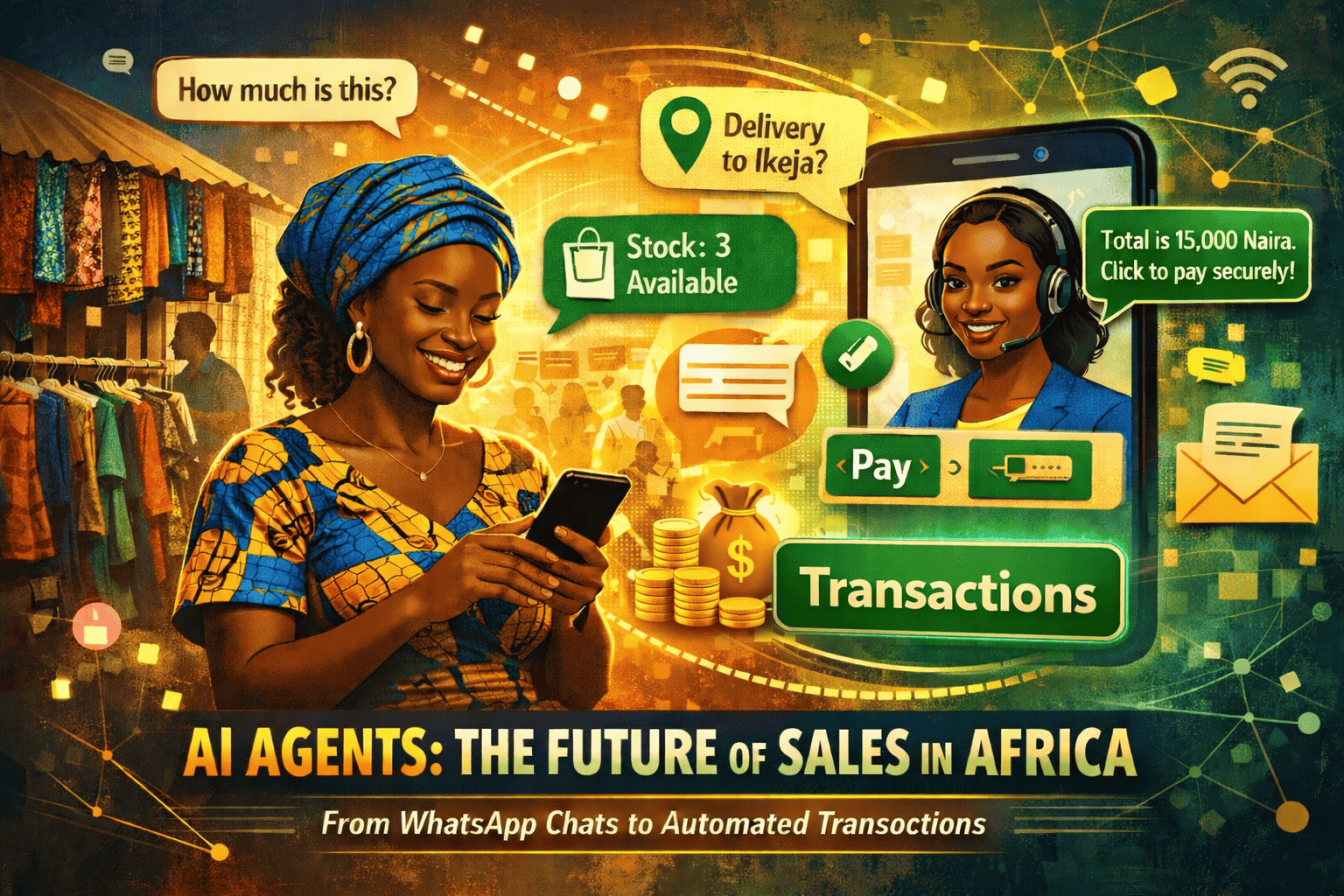

The era of the dumb chatbot is over. The era of the WhatsApp AI Sales Agent has arrived. In the bustling marketplaces of Africa, from the vibrant stalls of Lagos to the digital storefronts across Kenya, WhatsApp has become more than just a messaging app – it’s a primary sales channel.
For many Small and Medium Enterprises (SMEs), the sheer volume of inquiries on WhatsApp, Instagram DMs, and Facebook Messenger can be overwhelming. Many African business owners are already exploring tools for solopreneurs, but WhatsApp automation is the next step to reclaiming your time.
Each “How much is this?” or “Do you deliver to [location]?” represents a potential sale, but also a drain on precious time that could be spent on growth, product development, or strategic planning.
While rudimentary chatbots have been around for a while, offering canned responses, the year 2026 heralds a new era: AI Agents.
These aren’t just conversationalists; they are intelligent assistants capable of performing complex tasks and unlocking significant efficiency gains for African businesses operating on these popular platforms.
The WhatsApp Overload: A Familiar Pain Point
Picture this: You’re a fashion entrepreneur in Accra. Your latest designs are a hit, and your DMs are flooding. You’re juggling:
- Answering price inquiries
- Explaining sizing charts
- Confirming stock availability
- Processing order details
- Arranging delivery logistics
- Responding to “Is this still available?” messages
This manual, repetitive work consumes hours daily, often leading to delayed responses, frustrated customers, and crucially, lost sales. As your business grows, this becomes unsustainable.
Enter AI Agents: The Next Evolution in Automation
This is where AI Agents shine. Unlike traditional chatbots that are programmed with static responses, AI Agents are powered by advanced Large Language Models (LLMs) and can:
- Understand Context: They grasp the nuances of customer requests, even if phrased differently.
- Access & Process Data: They can connect to your inventory system to check stock, pull up pricing information, and even access customer order history.
- Perform Actions: This is the game-changer. An AI Agent can initiate actions like:
- Sending a direct payment link via mobile money or card (integrating with platforms like Paystack or Flutterwave).
- Generating and sending a proforma invoice.
- Confirming delivery addresses and estimated delivery times.
- Booking an appointment for a consultation or fitting.
- Gathering detailed product feedback.
- Learn and Improve: Over time, they can become even more efficient and personalised in their interactions.
Practical Applications for African SMEs in 2026
Imagine your WhatsApp business line buzzing, and instead of you rushing to type, an AI Agent is seamlessly handling the initial customer journey:
- Automated Order Processing: A customer asks, “I’d like the blue Ankara dress, size M.” The AI Agent checks availability, provides the price, and sends a Paystack payment link. Once confirmed, it collects the delivery details.
- Intelligent Lead Qualification: For service-based businesses, an AI Agent can ask qualifying questions (e.g., “What is your budget?”, “What is the desired outcome?”) before handing off high-intent leads to a human sales representative.
- 24/7 Customer Support: Customers can get instant answers to FAQs about product features, delivery timelines, or return policies, even outside business hours.
- Personalised Recommendations: Based on previous interactions or stated preferences, an AI Agent could suggest complementary products.
Getting Started: Tools to Explore
The good news is that you don’t need to be a tech wizard to leverage AI Agents. Several platforms are emerging or maturing that offer user-friendly interfaces and integrations relevant to the African market:
- WhatsApp Business API Integrations: Look for services that specialise in building custom AI Agent workflows on top of the WhatsApp Business API. These often offer visual builders and prebuilt e-commerce modules.
- AI-Powered CRM & Sales Tools: Many modern Customer Relationship Management (CRM) and sales platforms are integrating AI Agent capabilities that can automate communication across various channels, including WhatsApp.
- Dedicated AI Agent Platforms: Emerging platforms are focusing specifically on building and deploying AI Agents for various business functions. Many are designed to integrate with popular local payment gateways.
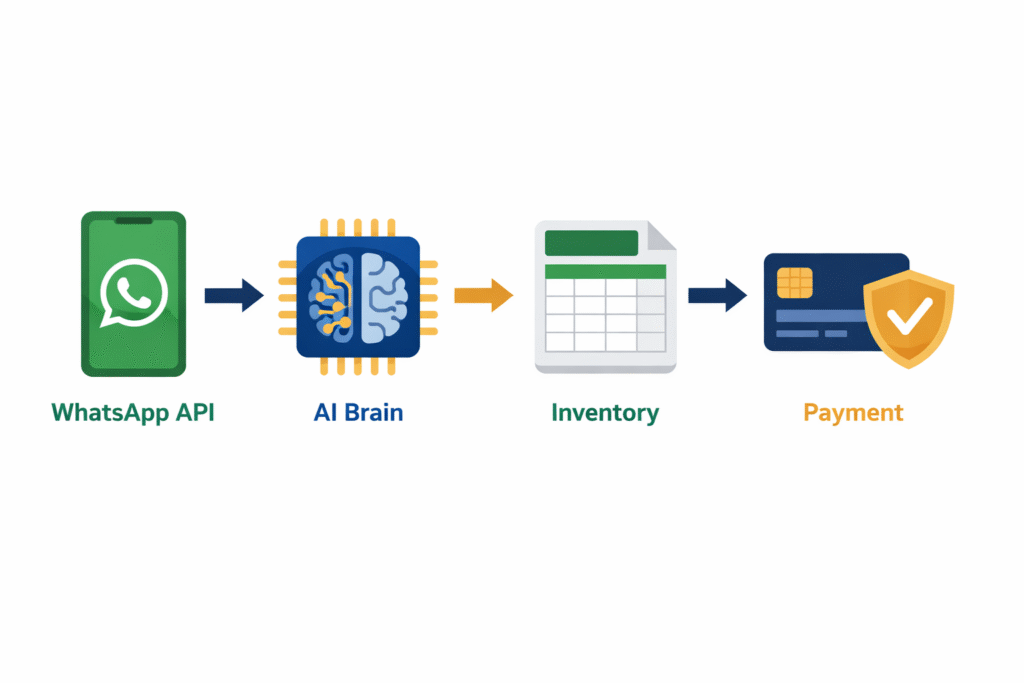
The “No-Code” Blueprint: Building Your WhatsApp AI Sales Agent
You do not need to be a software engineer. If you can use Google Sheets and drag-and-drop on a screen, you can build an AI Agent.
Step 1: Get Your “Business Line” Ready (The BSP)
You cannot do this on the regular WhatsApp app. You need the WhatsApp Business API.
- The misconception: People think this is only for big banks.
- The reality: You can access this through a Business Solution Provider (BSP).
- What to do: Sign up for a platform like Wati, Interakt, or MessageBird. These platforms act as the “interface” that connects your phone number to the AI brains. They handle the “Green Tick” verification for you.
Step 2: The Brain (The AI Builder)
This is where the magic happens. In 2026, we have “Visual Flow Builders.”
- The Tool: Platforms like Voiceflow, Stack AI, or Botpress (which have become incredibly user-friendly by 2026).
- The Setup:
- Create an account and choose a template (e.g., “E-commerce Sales Bot”).
- The Knowledge Base: This is the most crucial part. You don’t program answers. You upload a PDF of your product catalogue or connect a Google Sheet containing your inventory.
- The Prompt: You write a “System Prompt” in plain English.
- Example: “You are ‘Sisi,’ a friendly sales assistant for [Store Name]. You speak in a mix of professional English and Pidgin. You are helpful but concise. Your goal is to get the delivery address and Payment.”
Step 3: Connecting the Inventory (Google Sheets)
You don’t want to update the AI every time you manually sell an item.
- The Trick: Keep your inventory in a Google Sheet (Columns: Product Name, Price, Stock Status, Image Link).
- The Automation: Using a connector tool like Zapier or Make.com, you link the Google Sheet to your AI Agent.
- How it works: When a customer asks, “Is the Ankara Maxi available?”, the AI secretly “reads” your Google Sheet row 42, sees “Stock: 3”, and replies: “Yes! We have three left. Want me to secure one for you?”
Step 4: The Money (Payment & Logistics)
A conversation isn’t a sale until money moves.
- Payments: Do not manually request bank transfers. Connect your AI to Paystack, Flutterwave, or M-Pesa APIs.
- The flow: The AI generates a unique payment link inside the chat. “Total is 15,000 Naira. Click here to pay securely.”
- Verification: Once paid, the system automatically marks the order as “Paid.”
- Logistics: For advanced users, connect your AI to a logistics partner (like Gokada or Sendy).
- The AI collects the address, calculates the delivery fee based on the rider’s API, and adds it to the total bill.
A Real-World Scenario: The “2 AM” Sale
Here is exactly what this looks like for a customer while you are fast asleep.
Customer (2:14 AM): “Hi, I need a gift for my wife. Budget is like 20k.”
AI Agent: “Hello! That’s lovely. For 20k, our bestsellers are the Silk Scarf Set (15k) or the Gold Drop Earrings (18k). The earrings come in a gift box. Want to see a picture?”
Customer: “Let me see the earrings.”
AI Agent: [Pulls image from your database and sends it] “Here they are. We can deliver them to you by tomorrow afternoon if you order now.”
Customer: “Okay, let’s do it. Delivery to Ikeja.”
AI Agent: “Great choice! Delivery to Ikeja is 1,500. Total is 19,500. Here is your secure Paystack link. I’ll hold the item for 15 minutes.”
Customer: [Pays]
AI Agent: “Payment received! Order #402 confirmed. A dispatcher will call you tomorrow around 11 AM. Goodnight!”
You (7:00 AM): You wake up, check your dashboard, and see the money in your account and the delivery scheduled. You did nothing.

The “Trust Factor” : African Context
In our markets, people are sceptical of bots. They fear scams. While the continent debates who owns Africa’s AI future, local SMEs can take control today by deploying their own autonomous agents using the pro tips below.
Pro Tip for Setup:
- Human Handoff: Always configure the AI to say, “I am an automated assistant, but I can get a human manager if you need help.” If the customer gets frustrated, the AI must alert you immediately.
- Voice Notes: By 2026, advanced agents can receive voice notes (very common in African markets) and transcribe them to understand the request, or even reply with AI-generated voice notes in a local accent.
Your Action Plan for This Weekend
Don’t try to build Amazon overnight.
- Saturday: Clean up your inventory data. Put everything in a neat Google Sheet.
- Sunday: Sign up for a visual builder (like Voiceflow) and upload your document. Test the “Chat” feature to see if it answers questions correctly based on your data.
- Monday: Launch it for FAQs only (Hours, Location, Price List).
- Next Month: Integrate Payments.
The technology is here. The customers are waiting. The only question is: Are you going to keep typing, or are you going to start scaling?
3 Rules for Success (Don’t Skip These)
- Budget for Conversations: Remember that the WhatsApp Business API charges a small fee per conversation window. It’s cheap, but it’s not free like the personal app.
- Fuel the Engine: An AI Agent needs people to talk to. Use “Click-to-WhatsApp” ads on Instagram to drive traffic to your new automated salesperson.
- The “Hallucination” Clause: AI is smart, but not perfect. Always include a disclaimer that “Final prices and stock are subject to confirmation” to protect yourself from rare AI errors.
The Future is Automated, and It’s Here
For African SMEs looking to scale, increase customer satisfaction, and reclaim valuable time, embracing AI Agents for WhatsApp sales automation is no longer a luxury – it’s a necessity for staying competitive in 2026 and beyond.
This isn’t just about sales ; it’s about a fundamental shift in AI and productivity that allows you to focus on strategy instead of support tickets.
Start small. Identify your most repetitive customer inquiry, research a suitable platform, and begin automating one process. You’ll be amazed at the efficiency gains and the new opportunities that open up when your business runs smarter, not just harder.