


"ChatGPT is one of the most capable general-purpose AI tools available to Africans today because it can operate in multiple modes : everyday writing and learning, source-backed research via Deep Research, serious coding assistance via Codex, and visual creation through built-in image generation. Its raw intelligence is strong at structuring ideas, explaining concepts, drafting, and planning. But it is not consistently reliable as a factual authority. Hallucinations, small reasoning slips, and weak understanding of local African context can produce confident mistakes, especially when users treat outputs as final truth. The best way to use ChatGPT in Africa is to treat it like a high-speed assistant : let it draft, summarize, and propose options, then verify facts with sources, and sanity-check key decisions before acting."
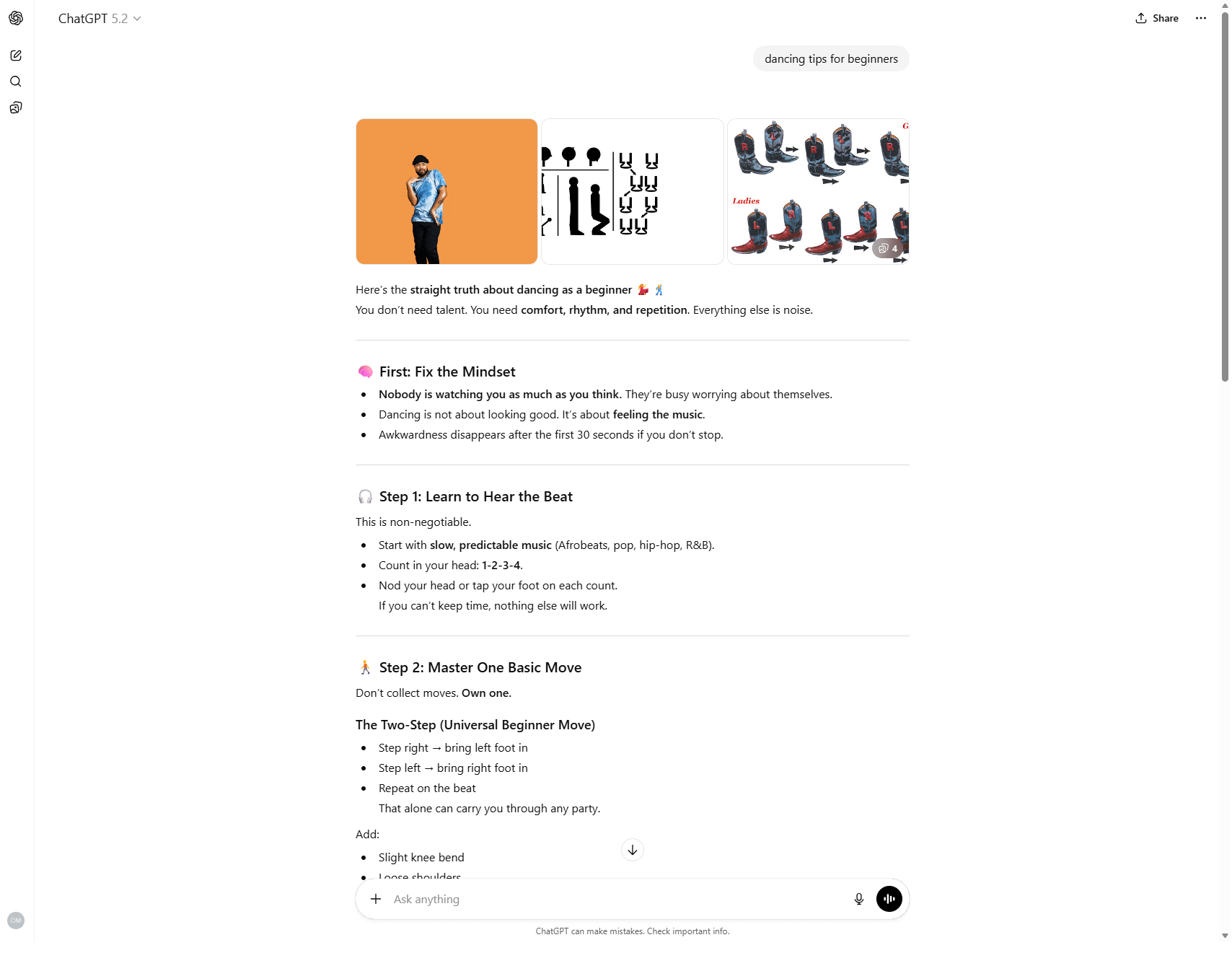
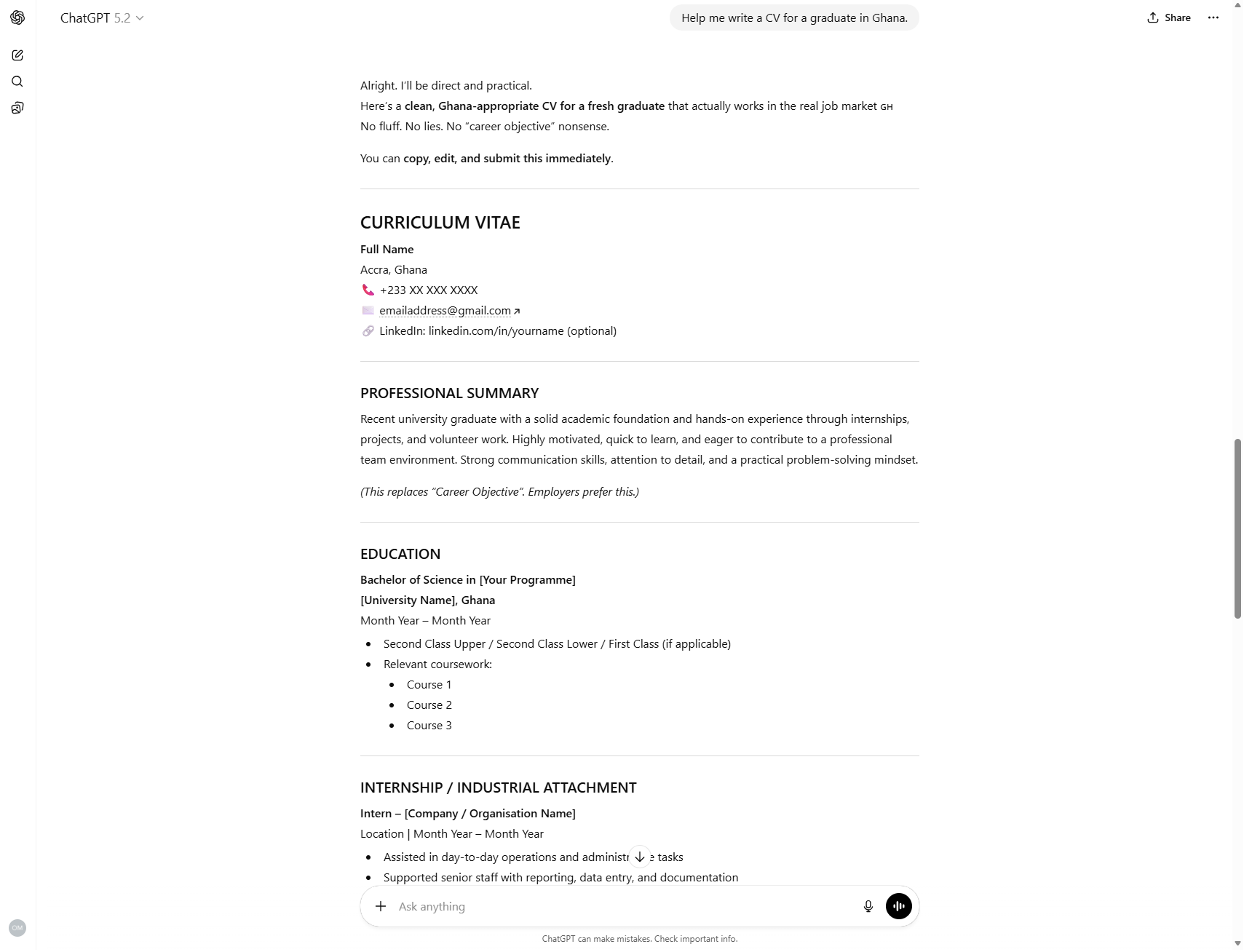

- Extremely useful for everyday tasks, especially writing, learning, and idea generation
- Low learning curve, beginners can start using it immediately
- Free version provides real value, not just a demo
- Text-based interface works better than most AI tools on weak networks
- Backed by a stable company, reducing the risk of sudden shutdown
- USD pricing and card-only payments make the paid plan inaccessible for many Africans
- Usage limits can feel unpredictable, even for paying users
- No offline or low-data mode, constant internet is required
- Long conversations become slow or unstable, affecting serious work
- Hallucinations are quite frequent and might ruin the experience
- Outputs often lack local context, requiring manual adaptation for African realities
The African Reality Test: Day-to-Day Use
Let’s be honest about how ChatGPT is actually used on the continent.
It is mostly used on phones
Not laptops. Not desktops. Phones.
ChatGPT’s mobile apps and mobile web interface are clean, readable, and fast enough. That alone puts it ahead of many AI tools that still feel desktop-first.
It survives weak internet… to a point
Text loads. Responses come through. Even on unstable LTE, ChatGPT often works when video tools completely fail.
But when the connection drops:
-
Long responses reset
-
Context is lost
-
Work disappears mid-thought
There is no true low-data or offline mode. That hurts.
Setup and Access: Where Friction Appears
Creating an account is relatively painless:
-
Email signup works
-
Phone verification can fail in some countries
-
No VPN required
Where the real friction begins is payment.
The Plus plan unlocks the best experience, but:
-
It is priced in USD
-
Requires a dollar card
-
FX conversion quietly increases the cost
-
No local payment options exist
For a student in Nigeria or Ghana, this is not a casual upgrade. It is a financial decision.
The Free Version vs Plus: The Real Difference
Free Version
-
Enough for learning and writing
-
Slower during peak hours
-
Limited access to newer models
This version is why ChatGPT spread so widely in Africa. It is genuinely useful at zero cost.
Plus Version
-
Faster
-
More capable
-
Better at complex reasoning
-
More stable during heavy use
But here is the truth:
The Plus version feels designed for users earning in dollars.
That gap matters.
Where ChatGPT Shines for African Users
Education
Students use it to:
-
Re-explain concepts
-
Break down complex ideas
-
Study independently
It does not replace education. It patches holes in broken systems.
Small Businesses
SMEs use it to:
-
Write customer messages
-
Draft proposals
-
Brainstorm ideas
It saves time. It reduces dependence on consultants.
Creators and Professionals
Writers, marketers, and founders use it to:
-
Beat blank-page paralysis
-
Organise thoughts
-
Improve consistency
ChatGPT does not make people creative.
It removes friction from being creative.
Where ChatGPT Struggles (And Why That Matters)
It is context-weak
ChatGPT often lacks:
-
Local market nuance
-
Regulatory understanding
-
Cultural specificity
African users must edit and adapt almost everything.
It is internet-dependent
No matter how good it is, a dead network means dead productivity.
In Africa, that is not a rare edge case. It is normal.
It quietly centralises dependency
When students and workers rely too heavily on ChatGPT:
-
Critical thinking can weaken
-
Verification can drop
-
Local knowledge can be sidelined
This is not unique to Africa, but the impact is stronger where alternatives are fewer.
Advanced Modes Africans Should Actually Use
ChatGPT is not just one tool. It is a bundle of modes that change what it can do.
Deep Research is particularly important for Africans because it addresses time-sensitive questions and mitigates the problem of “outdated training data” by sourcing and citing relevant materials. Use it for things like policy updates, scholarship deadlines, market research, and any claim that must be current.
Data Analysis is the hidden weapon for students and SMEs. Upload a spreadsheet, survey results, invoices, or a CSV and ask ChatGPT to clean the data, summarise trends, and generate charts. This saves hours and turns messy information into decisions.
Codex (coding agent) is for builders. Instead of just explaining code, it can help you work through real development tasks like debugging, refactoring, or generating tests if you give it a clear goal and constraints.
Images can help creators and small businesses generate posters, product mockups, and social content more quickly, but they are bandwidth-intensive and may not perform well on low-bandwidth networks.
Data, Trust, and Longevity
ChatGPT is backed by a stable company with global visibility. That reduces the risk of sudden disappearance.
However:
-
Conversations may be used for model improvement
-
Data localisation is unclear
-
Sensitive information should never be shared
African users should assume nothing is private by default.
Is Training Data a Problem?
Yes. It is.
ChatGPT does not have live, guaranteed, real-time knowledge by default. That means:
-
It may not know who won the most recent AFCON.
-
It may give outdated political, economic, or regulatory information.
-
It may confidently describe events that happened differently.
-
It may summarise local news incorrectly.
For African users, this matters more because:
-
Local coverage in training data is thinner.
-
African events are often underrepresented globally.
-
Regulatory and policy contexts change rapidly.
-
Users may not have easy access to alternative verification sources.
When ChatGPT confidently answers about African-specific events, you should assume it may be slightly outdated or context-misaligned.
Accuracy, Hallucinations & Context Gaps
ChatGPT sometimes generates answers that sound authoritative but are factually incorrect.
This includes:
-
Invented statistics
-
Fabricated citations
-
Incorrect legal or regulatory details
-
Confident summaries of things that do not exist
The problem is not that it guesses.
The problem is that it makes confident guesses.
For African users, this is dangerous because:
-
Many people use it for assignments
-
Some use it for business planning
-
Others use it for legal or immigration guidance
If you copy blindly, you can make public mistakes.
Reality: ChatGPT reduces effort. It does not eliminate verification.
Conclusion
ChatGPT is one of the most useful AI tools available to Africans today because it compresses time. It helps you write faster, learn faster, plan faster, and turn vague ideas into structured output without needing a tutor, consultant, or agency. For students, creators, and small business owners, that is a real advantage.
But it is not a truth machine. ChatGPT can hallucinate, miss context, and make simple mistakes while sounding confident. It can also be outdated on recent events and local realities unless you require it to use sources and verify the material. If you treat its answers as final, you will eventually get burned. If you treat it as a high-speed assistant that drafts, explains, and proposes options, then you can extract serious value safely.
Our verdict is straightforward: ChatGPT is worth using in Africa, especially on the free tier, but it works best with supervision. Use it for drafting, learning, brainstorming, and first-pass planning. Use Deep Research or external sources for anything time-sensitive or factual. And always sanity-check outputs when the stakes are high.