


"ChatGPT is the most feature-rich AI tool available in Africa, and the Go plan at ₦7,000 proves OpenAI is taking the continent seriously. The intelligence is world-class. But no mobile money payment, steep pricing beyond Go, and inconsistent African language support hold it back from an excellent rating. Start with Free, upgrade to Go when you hit limits, and only pay for Plus if Deep Research is essential to your work."

- GPT-5.2 is the most capable language model available today
- Go plan at ₦8,000/R155 makes ChatGPT genuinely affordable for Africa
- Deep Research is transformative for students and professionals
- Mobile app handles poor connectivity gracefully
- Canvas and Projects bring real productivity workflows
- Strong Swahili support and passable Nigerian Pidgin
- No mobile money payment — excludes millions of potential African users
- The free tier 10-message limit is too restrictive for real use
- Premium features locked behind $20/month Plus plan
- African language support beyond Swahili is inconsistent
- The Pro plan at $200/month is absurdly expensive outside wealthy markets
- Ads coming to the Go and Free tiers
- Hallucinations are quite frequent and might ruin the experience
- Outputs often lack local context, requiring manual adaptation for African realities
This ChatGPT review for Africa is based on weeks of hands-on testing across the continent from Lagos to Nairobi on MTN 3G, Safaricom 4G, and fibre broadband, using both the free tier and paid plans.
We ran real-world prompts that African users actually need: business proposals for West African markets, formal emails in South African English, AFCON factual queries, and even prompts in Swahili, Yoruba, and Hausa. Across six categories, including our unique Africa Accessibility metric, the honest verdict is that
After scoring against six categories, including our unique Africa Accessibility metric, here is the honest verdict: ChatGPT scores 74 out of 100.
That is a solid “Good” rating—not excellent —and here is why. ChatGPT remains the most capable general-purpose AI tool available in 2026. The intelligence is there.
The problem is everything surrounding it: pricing that does not account for African purchasing power, payment systems that exclude the continent’s most popular methods, and network performance that was clearly optimised for users with unlimited fibre connections.
If you are reading this from Accra, Addis Ababa, or Johannesburg, this review will tell you things that no other review on the internet covers.
What Is ChatGPT in 2026?
ChatGPT is OpenAI’s flagship AI assistant, and in 2026, it looks nothing like the simple chatbot that launched in November 2022. The current version runs on the GPT-5.2 model family, which comes in three flavours: Instant (fast responses for everyday tasks), Thinking (slower, deeper reasoning for complex problems), and Pro (maximum compute power for professional workloads).
Beyond text chat, ChatGPT now includes a full ecosystem of tools. Canvas lets you edit documents and code side by side with the AI.
Sora 2 generates high-definition video from text descriptions. Deep Research acts as a research assistant, searching the web, reading dozens of sources, and producing structured reports. Agent Mode can perform multi-step tasks autonomously, including spoken conversations with the AI, on mobile devices, when analysing and naming scheduling data, and when interacting with connected apps such as Gmail, Google Drive, and Slack.
The reasoning model, o3, handles complex mathematics, scientific analysis, and coding challenges that previous models struggled with. Memory now works across all your conversations, so ChatGPT remembers your preferences, writing style, and project details without being told every time. Advanced Voice Mode lets you have natural spoken conversations with the AI, including on mobile.
For African users, the most significant development is the introduction of the ChatGPT Go plan in October 2025, priced at ₦8,000 per month in Nigeria and R155 per month in South Africa. This is OpenAI explicitly acknowledging the African market — and we will dig into exactly what that plan includes and excludes later in this review.
ChatGPT Setup and Access: Where Friction Appears
Creating an account is relatively painless:
Email signup works
Phone verification can fail in some countries
No VPN required
Where the real friction begins is payment.
The Plus plan unlocks the best experience, but:
It is priced in USD
Requires a dollar card
FX conversion quietly increases the cost
No local payment options exist
For a student in Nigeria or Ghana, this is not a casual upgrade. It is a financial decision.
ChatGPT Plans and Pricing for Africa
This is the section that no other ChatGPT review covers properly. Pricing is not just about the dollar amount it is about whether you can actually pay, what currency you are billed in, and whether the features you get are worth a day’s wages in your country.
| Plan | Global Price | Nigeria (₦) | South Africa (R) | Key Limits |
|---|---|---|---|---|
| Free | $0 | ₦0 | R0 | Good for writing and learning. Limits on top models and advanced modes. No Deep Research. |
| Go | ~$5.00 | ₦8,000 | R155 | Higher limits and faster experience. More uploads and image tools. No Deep Research. |
| Plus | $20/mo | ~₦32,000 | R399+ | Best overall tier for serious work. Advanced modes like Deep Research and stronger reasoning workflows. |
| Pro | $200/mo | ~₦320,000 | R3,999+ | Maximum compute and highest limits. For power users and heavy workloads. |
The Payment Problem
Here is where it gets frustrating. OpenAI accepts Visa and Mastercard, and that is it. No M-Pesa. No MTN Mobile Money. No Airtel Money. No bank transfers. In a continent where mobile money accounts outnumber traditional bank accounts in many countries, this is a significant barrier.
South Africa is the only exception where OpenAI introduced rand-based billing in October 2025, eliminating exchange-rate surprises. For Nigeria, Kenya, Ghana, and most other African countries, you need a dollar-denominated Visa or Mastercard. Many African debit cards will not work because they are not enabled for international online payments. You may need to use a virtual dollar card from services like Chipper Cash, Grey, or Payday to subscribe.
Is the Go Plan Worth It in Africa?
The Go plan at ₦8,000 per month is genuinely affordable by Nigerian standards , roughly the cost of a modest lunch for two in Lagos. It removes the frustrating 10 messages per 5-hour limit on the free tier and gives you unlimited access to GPT-5.2 Instant, the fastest model and perfectly adequate for most daily tasks: writing, research, brainstorming, coding assistance, and data analysis.
What Go does not include matters too. You do not receive Deep Research (arguably the single most valuable feature for students and professionals). You do not get Sora video generation. You do not get the Thinking model for complex reasoning tasks. And OpenAI has announced it will begin testing advertisements in the Go and Free tiers so expect ads to appear in your conversations in the near future.
Our recommendation: if you are a student or casual user, the ₦7,000 Go plan is an excellent value. If you are a professional, freelancer, or business owner who needs Deep Research and advanced reasoning, you need Plus at $20 per month to resolve the payment method issue.
The Free Version vs Plus: The Real Difference
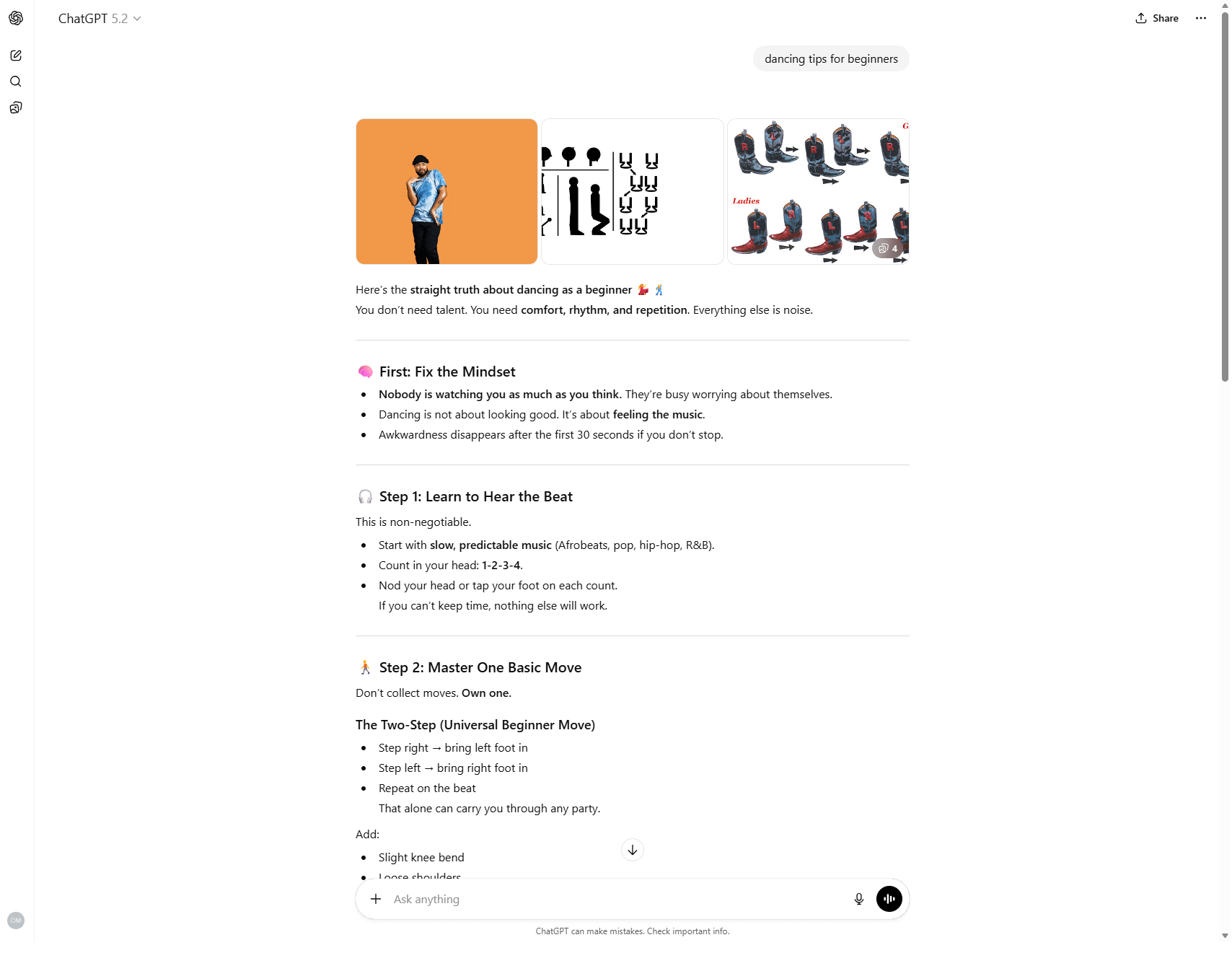
A lot of people think “Pro/Plus makes it smarter.” The larger difference is that you can handle heavier workflows more reliably and use advanced capabilities more often (files, images, deeper tasks). In the comparison below, we compared the free and pro versions (with extended thinking enabled), and you can see the differences in the answers.
Free Version
Enough for learning and writing
Slower during peak hours
Limited access to newer models
This version is why ChatGPT spread so widely in Africa. It is genuinely useful at zero cost.
Plus Version
Faster
More capable
Better at complex reasoning
More stable during heavy use
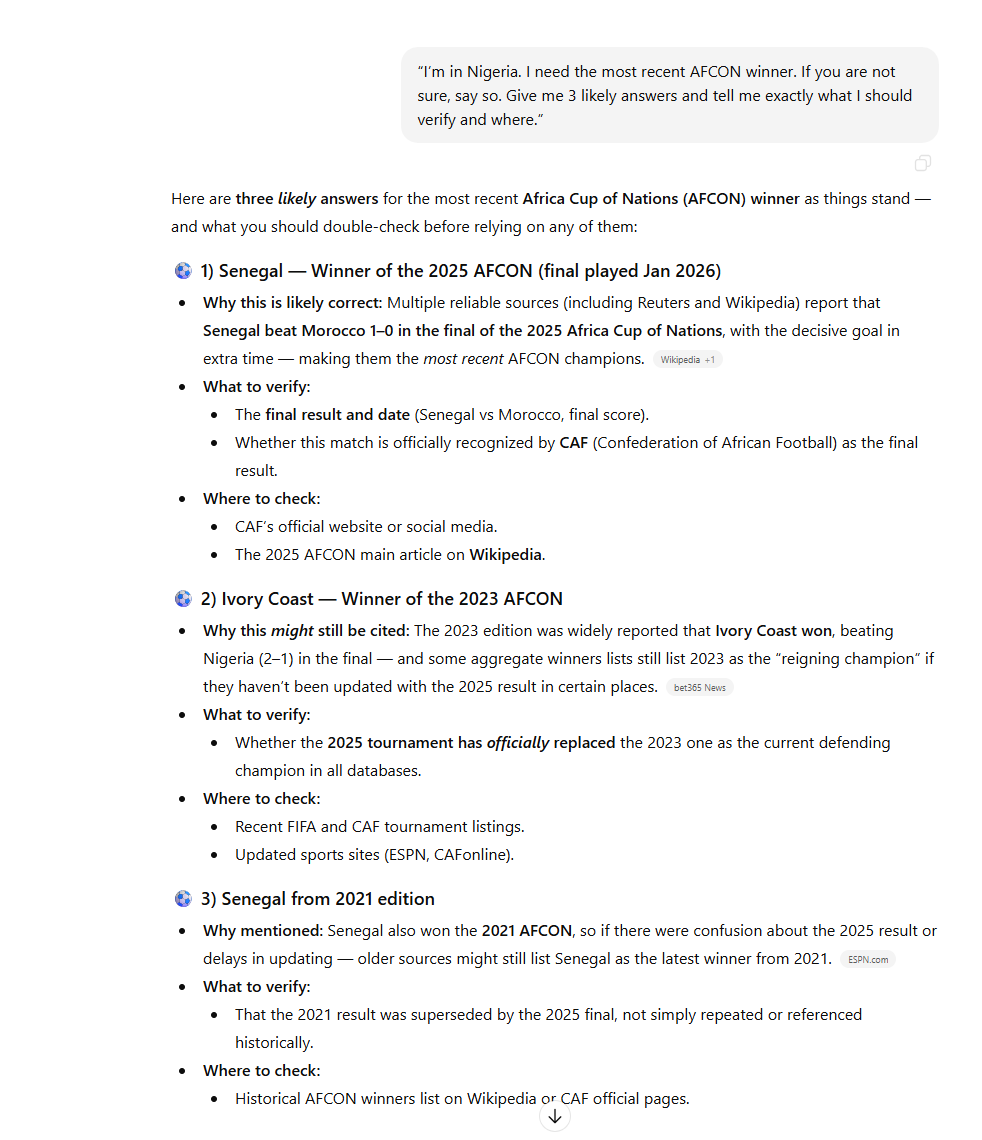
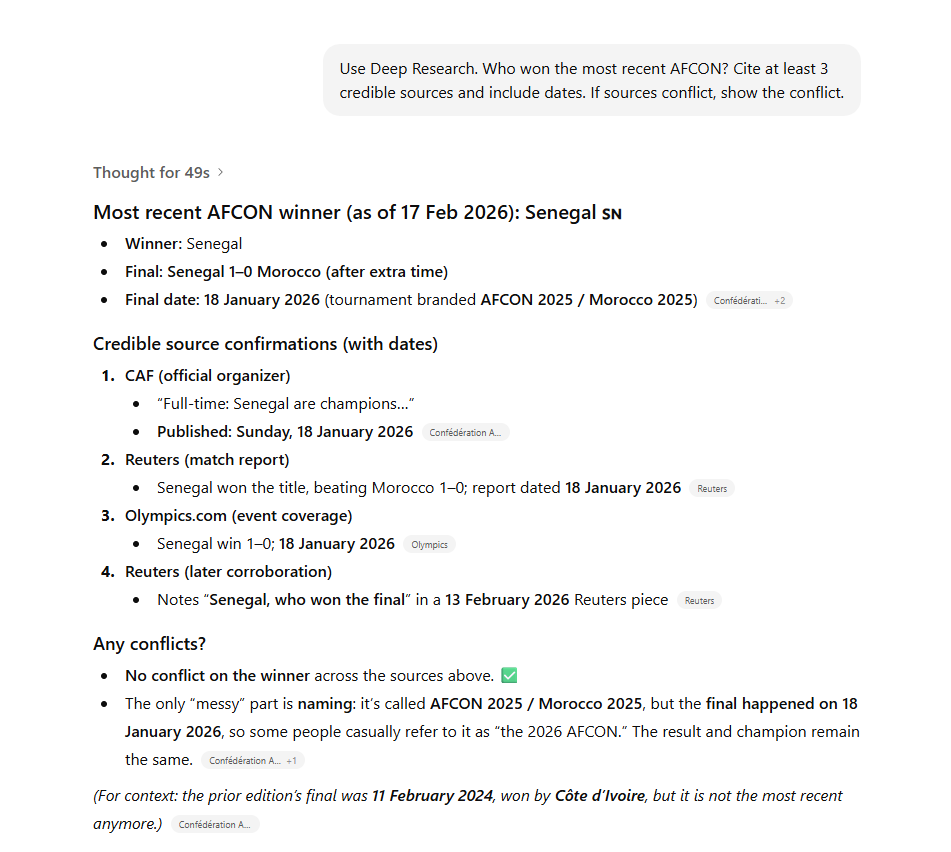
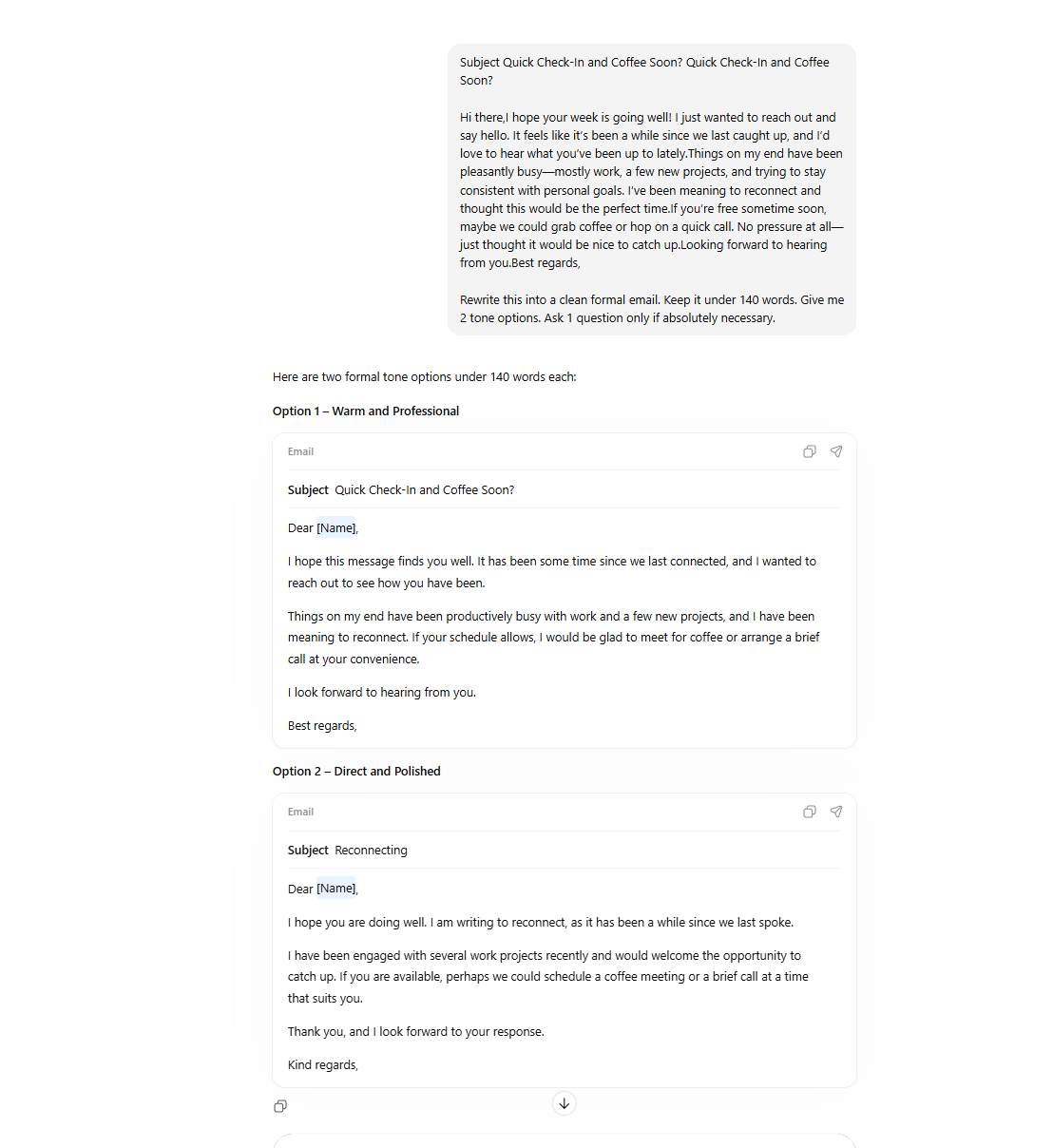
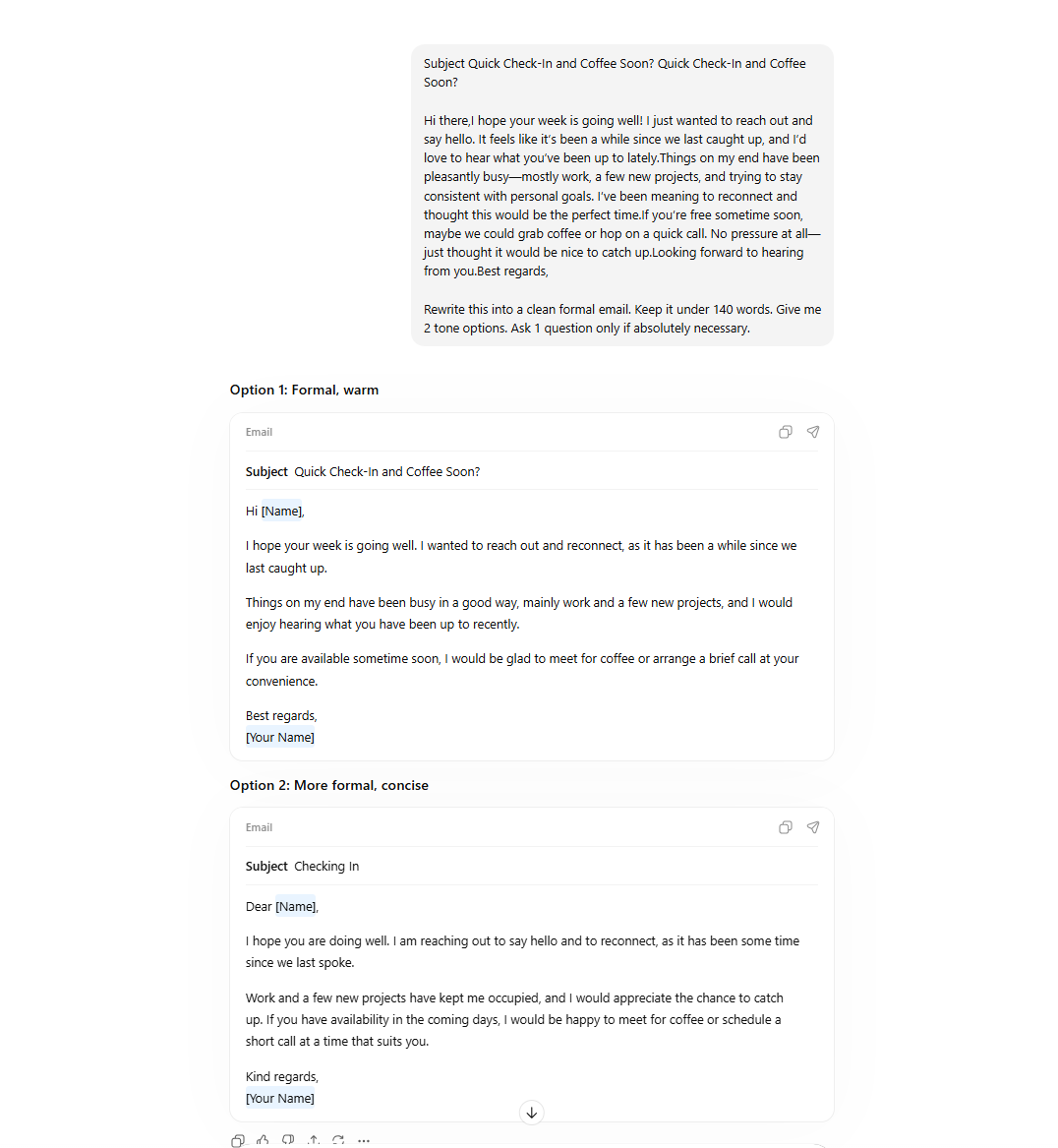
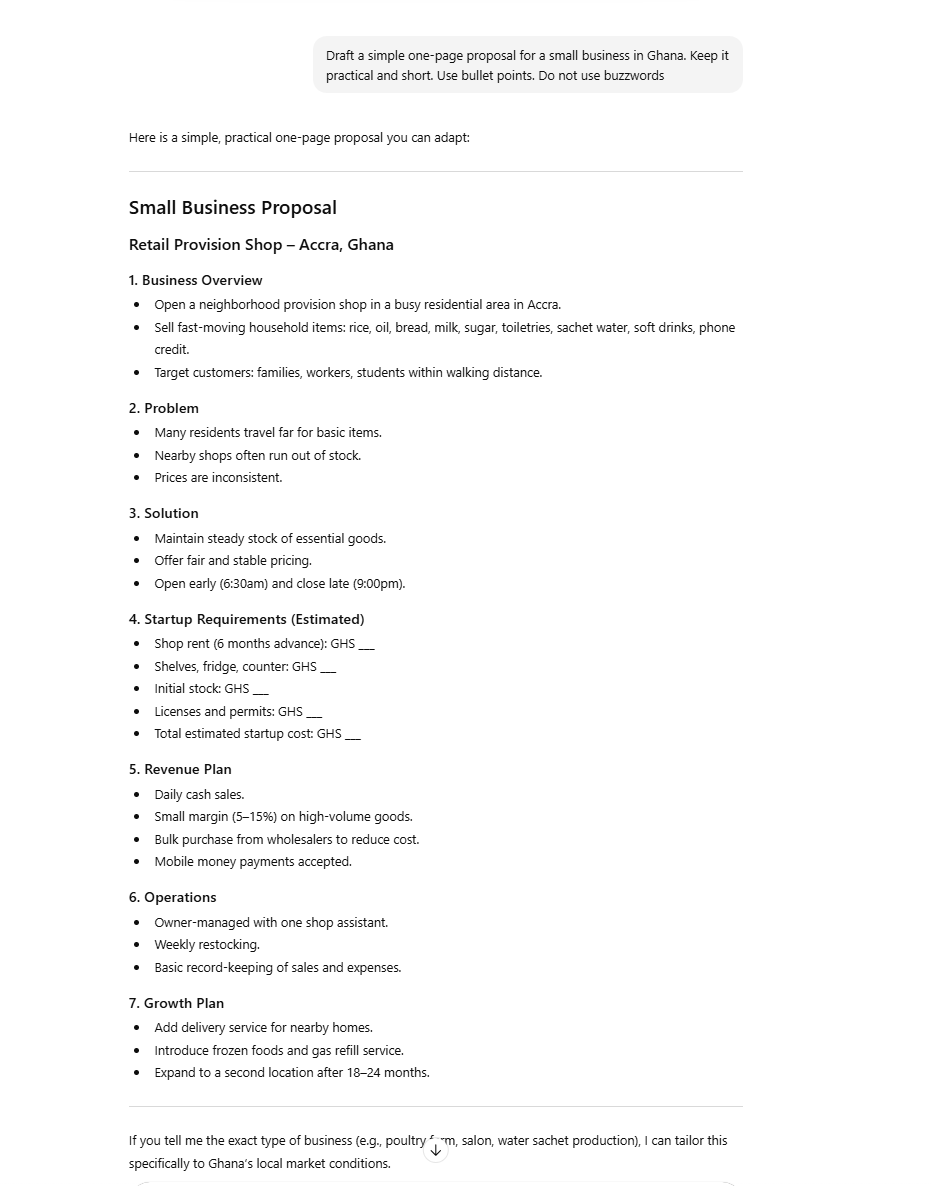
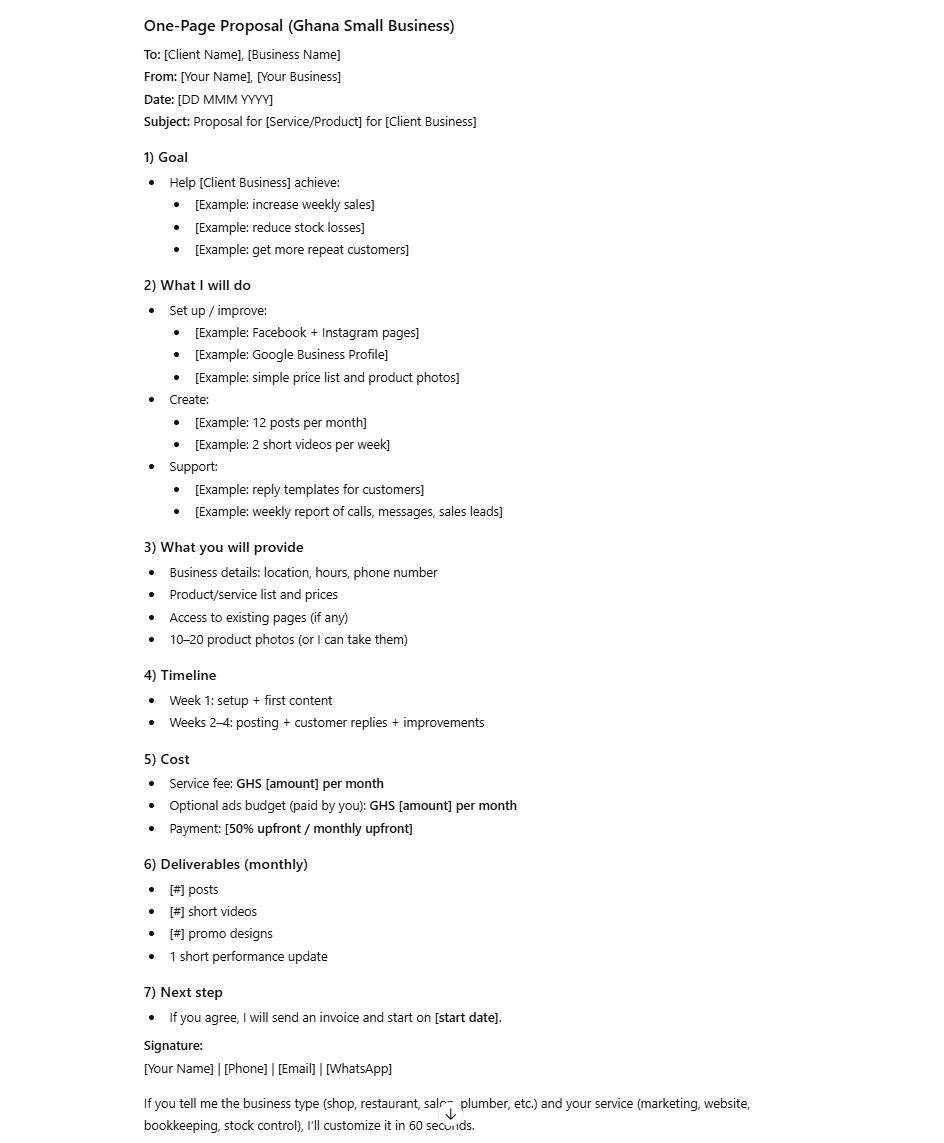
Free vs Plus: Same Prompt, Different Output
We tested identical prompts on both the Free and Plus tiers to show you the real difference. This is not marketing copy — these are actual results from the same prompts run side by side.
Hands-On: Testing ChatGPT in African Conditions
This is the heart of this ChatGPT review for Africa, real testing in real conditions that African users face daily.
Business and Professional Tasks
We ran ChatGPT through a series of Africa-specific professional tasks. It drafted a convincing grant proposal for a Nairobi-based EdTech startup, complete with references to Kenya’s Competency-Based Curriculum and realistic budget figures in Kenyan shillings. It rewrote a formal letter to the South African Reserve Bank in appropriately regulatory language. It created a one-week social media content calendar for a Lagos fashion brand targeting the Nigerian market, including culturally relevant hashtag suggestions and post timing optimised for West African time zones.
Where it stumbled: ChatGPT occasionally defaulted to American business conventions. When drafting a partnership agreement, it used American legal terminology rather than the common-law framework most Anglophone African countries follow. When asked about tax implications, it initially provided US tax information before we specified the jurisdiction. You need to be explicit about location in your prompts ChatGPT does not assume you are in Africa.
Factual Accuracy on African Topics
We tested ChatGPT’s knowledge of Africa-specific facts. It correctly identified Kenya as the world’s leading ChatGPT user country by adoption rate (42.1% of internet users, per Data Report July 2025). It accurately described M-Pesa’s role in Kenya’s financial ecosystem. It knew the 2024 AFCON was held in Côte d’Ivoire and correctly named the hosts as eventual winners.
However, it made errors on more obscure topics. When asked about specific Nigerian state-level policies, it occasionally conflated federal and state regulations. It was weaker on East African Community trade details and sometimes presented outdated statistics on internet penetration in Africa. For factual research about Africa, we strongly recommend using Deep Research mode (Plus only), which verifies information against current web sources rather than relying on training data alone.
Handling African Names, Locations, and Currencies
ChatGPT handles common African names well, correctly spelling and recognising names like Oluwaseun, Abimbola, Wanjiku, Amahle, and Chukwuemeka without requiring correction. It understood references to specific locations like Lekki, Karen (Nairobi), Sandton, and Kumasi without confusing them with similarly named places elsewhere.
Currency handling was mixed. It correctly converted between USD, NGN, KES, ZAR, and GHS when asked. But it sometimes uses outdated exchange rates from its training data rather than current rates, which matters when you are doing business calculations. Always double-check currency conversions with a live rate source.
ChatGPT on African Networks
Network performance is a dealbreaker for many African users, yet no Silicon Valley review site tests it.
3G Performance
On a 3G connection (typical for many areas outside major cities), ChatGPT’s web interface was slow but functional. Initial page load took 8-12 seconds. Once loaded, text responses streamed in with noticeable delay — roughly 2-3 seconds before the first word appeared, compared to near-instant on 4G. Importantly, ChatGPT does not lose your conversation if the connection drops briefly. The app reconnects and your prompt history is preserved. This is a meaningful advantage over some competitors that lose context on disconnection.
4G and Wi-Fi Performance
On Safaricom 4G in Nairobi and MTN 4G in Lagos, performance was comparable to what you would experience in any developed market — fast, responsive, with no noticeable lag. The mobile app (both iOS and Android) performed better than the web browser on slower connections because it is optimised for mobile data.
Data Usage
We monitored data consumption during testing. A typical 30-minute ChatGPT session using text only consumed approximately 5-8 MB of data. Adding image generation bumped this to 15-25 MB per session. Deep Research, which loads and processes multiple web pages, used 30-50 MB per research query. For users on capped data plans, this is important: a heavy daily user might consume 200-400 MB per month on ChatGPT alone.
Mobile App vs Browser
The mobile app is the better choice for African users. It loads faster, handles poor connectivity more gracefully, and includes voice input, which is useful when typing on small screens or in languages that are easier to speak than type. The app is available for both iOS and Android and is relatively lightweight at around 150 MB installed.
African Language Support
We tested ChatGPT’s ability to understand and respond in six major African languages. The results varied significantly.
Swahili (Kiswahili)
Strong performance. ChatGPT understood Swahili prompts accurately and responded fluently with correct grammar and vocabulary. It handled code-switching (mixing Swahili and English, as many East Africans naturally do) without confusion. We asked it to explain compound interest in Swahili, and the explanation was clear and accurate. This is unsurprising given the size of Swahili’s online text corpus.
Yoruba
Moderate performance. ChatGPT understood basic Yoruba prompts and could respond in Yoruba, but with noticeable grammatical errors and occasional gaps in vocabulary. It struggled with tonal marks a critical element of written Yoruba that changes word meaning entirely. For casual conversation, it was usable, but for any formal or educational Yoruba content, you would need to edit the output carefully.
Hausa
Similar to Yoruba, functional but imperfect. ChatGPT understood common Hausa phrases and could carry on a basic conversation. It occasionally mixed up dialectal variations (Kano vs. Sokoto Hausa). For simple tasks like translation or basic Q&A, it works. For professional-quality Hausa content, it falls short.
Amharic
Weaker performance. ChatGPT could recognise Amharic script (Ge’ez) and attempted responses, but accuracy dropped noticeably. Grammar errors were frequent, and it sometimes responded in a mixture of Amharic and Tigrinya. For Ethiopian users who are comfortable in English, we recommend prompting in English and asking for Amharic translation only for specific phrases.
Zulu (isiZulu)
Moderate performance, similar to Yoruba. ChatGPT understood basic isiZulu and could respond, but struggled with the noun-class system central to Bantu languages. Simple conversations worked, complex or formal content did not.
Pidgin English (Nigerian)
Surprisingly good. ChatGPT understood and responded in Nigerian Pidgin with reasonable fluency. It captured the tone and informal structure well, making it useful for content creators who produce Pidgin content for social media or entertainment.
Overall, ChatGPT is strongest in English (including African varieties) and Swahili. For other African languages, it is a useful starting point, but not a reliable final output ; always have a native speaker review the content.
Who Should Use ChatGPT in Africa?
Students
ChatGPT is arguably the most impactful AI tool for African students. The free tier alone can help with essay research, exam preparation, understanding complex topics, and practising language skills. For university students writing dissertations or conducting literature reviews, the Deep Research feature (Plus only) is transformative. It does in three minutes what used to take three hours of manual web searching.
A word of caution: African universities are increasingly adopting AI detection tools. ChatGPT should be used as a research assistant and brainstorming partner, not as a ghostwriter. Use it to understand concepts, outline arguments, and find sources, then write in your own voice.
Freelancers and Content Creators
If you are a freelance writer, designer, marketer, or developer in Africa, ChatGPT can meaningfully increase your output. It drafts client proposals in minutes. It rewrites content for different audiences. It generates social media copy, email sequences, and blog outlines. For developers, it helps debug code, explain error messages, and suggest optimisations across most programming languages.
The Go plan at ₦7,000 per month is likely sufficient for most freelancers. Upgrade to Plus if you regularly need Deep Research or if you create visual content and want access to better image generation limits.
Small Business Owners
ChatGPT can serve as a budget consulting team for small businesses. We tested it as a customer service draft tool, a marketing copy generator, a business plan reviewer, and a financial calculation assistant. It performed well in all categories, especially when given specific context about the business and its market.
Specific use cases that work well for African SMEs: drafting responses to customer complaints on social media, creating product descriptions for e-commerce listings, translating marketing materials between English and local languages, and preparing simple financial projections. It cannot replace an accountant or a lawyer, but it can do 80% of the preliminary work for many business tasks.
Developers
For African developers — whether building fintech applications, mobile-first platforms, or enterprise software — ChatGPT is an excellent coding companion. It understands Python, JavaScript, PHP, Java, C++, and most other popular languages. The Canvas feature lets you edit code collaboratively with the AI, and the Codex agent (Plus and above) can write, test, and debug code more autonomously.
Where ChatGPT Shines for African Users
Education
Students use it to:
- Re-explain concepts
- Break down complex ideas
- Study independently
It does not replace education. It patches holes in broken systems.
Small Businesses
SMEs use it to:
- Write customer messages
- Draft proposals
- Brainstorm ideas
- It saves time. It reduces dependence on consultants.
Creators and Professionals
Writers, marketers, and founders use it to:
- Beat blank-page paralysis
- Organise thoughts
- Improve consistency
ChatGPT does not make people creative.
It removes friction from being creative.
Where ChatGPT Struggles (And Why That Matters)
It is context-weak
ChatGPT often lacks:
- Local market nuance
- Regulatory understanding
- Cultural specificity
African users must edit and adapt almost everything.
It is internet-dependent
- No matter how good it is, a dead network means dead productivity.
- In Africa, that is not a rare edge case. It is normal.
It quietly centralises dependency
When students and workers rely too heavily on ChatGPT:
- Critical thinking can weaken
- Verification can drop
- Local knowledge can be sidelined
This is not unique to Africa, but the impact is stronger where alternatives are fewer.
Advanced Features Africans Should Actually Use
ChatGPT is not one tool. It is a stack of capabilities, and the real value depends on choosing the right mode for the job. Here is what matters, what it does well, and where it can still fail.
Deep Research
Deep Research is the most important feature for Africans because it reduces the “old knowledge” problem by sourcing information and citing sources.
What it’s best for
- Time-sensitive facts (sports results, elections, policy changes, new laws, deadlines)
- Market research and competitor scans
- Scholarship and visa requirements that change often
- “What do credible sources say?” questions often
Critical reality
- Citations can create false confidence. You still need to click and verify because the model can misread sources or cite irrelevant pages.
- If the web is noisy (blogs, copied articles, low-quality summaries), Deep Research can still produce a polished but misleading report.
- For high-stakes decisions, treat it like a researcher, not a judge.
How to use it properly
Ask for: sources, dates, and contradictions. If it cannot confirm, it should say so.
Data Analysis
Data Analysis turns ChatGPT into a practical assistant for spreadsheets and numbers. This is where it stops being “just chat” and starts saving real time.
What it’s best for
- Cleaning messy CSVs and spreadsheets
- Summarising sales, expenses, invoices, and survey results
- Creating charts and quick dashboards
- Finding patterns you would miss manually
Critical reality
- It can make arithmetic or interpretation mistakes if your data is inconsistent or if columns are unclear. You must sanity-check totals and assumptions.
- Bad inputs produce confident nonsense. If you upload incomplete data, you get a clean-looking but wrong output.
- It is not an accounting authority. It is a fast analyst.
How to use it properly
Tell it what each column means, define your currency, and request explicit checks like “show your calculation steps” and “flag anomalies.”
Codex (Coding Agent)
Codex is for shipping software, not for explaining software. It is most useful when you treat it like a junior engineer that works fast but needs oversight.
What it’s best for
- Debugging errors when you can provide the code and the context
- Refactoring messy code into cleaner structures
- Writing tests and improving reliability
- Implementing small features quickly
Critical reality
- It can introduce subtle bugs that “look correct.” If you don’t run tests or review diffs, it can quietly break things.
- If your requirements are vague, it will fill gaps with assumptions. That is where most software mistakes come from.
- It is powerful, but it is not accountable. You are still the engineer of record.
How to use it properly
Give constraints, ask it to explain changes, and require tests or validation steps.
Images
Image generation is useful for marketing and content, especially if you’re trying to move fast.
What it’s best for
- Social media graphics and poster concepts
- Thumbnails, covers, and basic product mockups
- Rapid creative iteration for creators and SMEs
Critical reality
- It is bandwidth-heavy and can be frustrating on weak networks.
- It can produce outputs that look good but are off-brand unless you give strict style rules.
- It can hallucinate details like fake UI elements, wrong logos, or unreadable small text. You often need a second pass.
How to use it properly
Use simple layouts, bigger text, fewer elements, and always review for accuracy and readability on mobile.
Data, Trust, and Longevity
ChatGPT is backed by a stable company with global visibility. That reduces the risk of sudden disappearance.
However:
- Conversations may be used for model improvement
- Data localisation is unclear
- Sensitive information should never be shared
African users should assume nothing is private by default.
Is Training Data a Problem?
Yes. It is.
ChatGPT does not have live, guaranteed, real-time knowledge by default. That means:
- It may not know who won the most recent AFCON.
- It may give outdated political, economic, or regulatory information.
- It may confidently describe events that happened differently.
- It may summarise local news incorrectly.
For African users, this matters more because:
- Local coverage in training data is thinner.
- African events are often underrepresented globally.
- Regulatory and policy contexts change rapidly.
- Users may not have easy access to alternative verification sources.
When ChatGPT confidently answers about African-specific events, you should assume it may be slightly outdated or context-misaligned.
Accuracy, Hallucinations & Context Gaps
ChatGPT sometimes generates answers that sound authoritative but are factually incorrect.
This includes:
- Invented statistics
- Fabricated citations
- Incorrect legal or regulatory details
- Confident summaries of things that do not exist
The problem is not that it guesses.
The problem is that it makes confident guesses.
For African users, this is dangerous because:
- Many people use it for assignments
- Some use it for business planning
- Others use it for legal or immigration guidance
- If you copy blindly, you can make public mistakes.
Reality: ChatGPT reduces effort. It does not eliminate verification.
What does ChatGPT Plus actually cost in local terms?
ChatGPT Plus is $20/month.
Below is what $20 looks like converted using recent mid-market rates (your bank may charge more).
Quick conversion snapshot (Plus = $20/month)
| Country | Approx local cost | What that roughly equals (basic item comparison) |
|---|---|---|
| Nigeria | ₦27,651 | about 6 inexpensive meals (Lagos benchmark) (Wise) |
| Ghana | GH₵220 | about 3 inexpensive meals (Accra benchmark) (Wise) |
| Kenya | KSh 2,580 | about 3–4 inexpensive meals (Nairobi benchmark) (Wise) |
| South Africa | R319 | about 1–2 inexpensive meals (Johannesburg benchmark) (Wise) |
Reality check: This is why Africans say Plus “feels priced for dollar earners.” The value is real, but the affordability is not evenly distributed.
ChatGPT Review for Africa: Score Breakdown and Methodology
FanalMag scores every AI tool across six categories. Here is what each score means for ChatGPT and how we arrived at our rating.
Features and Capability — 80/100: ChatGPT offers the broadest feature set of any AI tool: text, code, images, video, voice, research, and automation. It loses points because many premium features (Deep Research, Sora, Agent Mode) are locked behind the $20/month Plus tier, making the free and Go experiences significantly less capable.
Ease of Use — 80/100: The interface is clean and intuitive. The mobile app is excellent. Canvas and Projects are well-designed. It loses points because the sheer number of features can be overwhelming for new users, and the model-switching system (Instant vs Thinking vs Pro) adds unnecessary complexity.
Africa Accessibility — 73/100: This is FanalMag’s unique metric. ChatGPT gets credit for launching the Go plan across all 54 African countries, introducing local-currency billing in South Africa, and performing reasonably well on 3G networks. It loses significant points for accepting only Visa/Mastercard (no mobile money), using outdated African data in its training set, and not prioritising African language support.
Value for Money — 58/100: This is ChatGPT’s weakest score for African users. The Go plan is a good value. But the Plus plan at $20/month is expensive relative to income levels across most of Africa. The Pro plan at $200/month is out of reach for virtually all individual users. And the free tier’s strict limits make it feel more like a trial than a usable product.
Reliability and Speed — 70/100: ChatGPT works well on 4G and Wi-Fi, but it slows noticeably on 3G. We experienced occasional downtime during peak hours (which align with US business hours, not African). The 160 messages-per-3-hour-period limit on Plus during peak times is frustrating for power users.
Output Quality — 80/100: When given clear prompts, ChatGPT produces excellent output across writing, analysis, coding, and research. It understands African English conventions, handles most African contexts well, and the GPT-5.2 model is noticeably smarter than previous versions. It loses points for inconsistent support for African languages and occasional factual errors on Africa-specific topics.
The Good and the Bad
What We Liked
GPT-5.2 is the most capable language model available today — the reasoning quality is exceptional. The Go plan at ₦7,000/R149 makes ChatGPT accessible to a much broader African audience. Deep Research is genuinely transformative for anyone who does regular research. The mobile app handles poor connectivity gracefully without losing conversation context. Canvas and Projects bring real productivity workflow features. Strong Swahili support and passable Nigerian Pidgin understanding.
What Needs Improvement
No mobile money payment support — this excludes millions of potential African users. The free tier’s 10-message limit is too restrictive to be genuinely useful. Many premium features (Deep Research, Sora, Agent Mode) require the $20/month Plus plan, which is expensive for most Africans. Support for African languages beyond Swahili and English is inconsistent. The Pro plan at $200/month is absurdly expensive outside of wealthy markets. Ads are coming to the Go and Free tiers. ChatGPT sometimes defaults to the American context and requires explicit location prompting.
ChatGPT vs Alternatives for Africa
ChatGPT is not the only option. Here is how it compares to the main alternatives for African users.
| Tool | Best For | Free Tier | Paid Price | Africa Score |
|---|---|---|---|---|
| ChatGPT | All-rounder | Limited (10 msg/5 hrs) | From ₦7,000/mo | 74/100 |
| Claude | Writing, analysis, coding | Generous free tier | $20/mo | Review coming |
| Gemini | Google integration | Good free access | $7.99/mo | Review coming |
| Perplexity | Research with sources | Decent free tier | $20/mo | Review coming |
We will be publishing full Africa-focused reviews of Claude, Gemini, and Perplexity in the coming weeks. For now, ChatGPT’s combination of features, the affordable Go plan, and its mobile app give it the edge as the most accessible general-purpose AI tool for African users.
Frequently Asked Questions: ChatGPT in Africa
Is ChatGPT free in Africa?
Yes, there is a free tier available across the continent. However, it limits you to roughly 10 messages per 5-hour period on the GPT-5.2 model, after which you are downgraded to a less capable Mini model. For regular use, the Go plan starting at ₦7,000/month in Nigeria is the most affordable upgrade.
Can I pay for ChatGPT with mobile money or M-Pesa?
No. As of February 2026, OpenAI only accepts Visa and Mastercard for all subscription plans. This means M-Pesa, MTN Mobile Money, Airtel Money, and similar services are not supported. You will need a dollar-enabled debit or credit card, or a virtual card from services like Chipper Cash or Grey.
Does ChatGPT work on slow internet in Africa?
It works on 3G, but expect slower loading times (8-12 seconds for the initial load, 2-3 second delays in responses). On 4G, it performs normally. The mobile app handles spotty connections better than the web browser. Your conversations are saved even if you briefly lose connection.
Is ChatGPT Plus worth $20 per month in Nigeria or Kenya?
That depends on your use case. At ₦32,000 or KES 2,580 per month, it is a significant expense. If you are a student, the Go plan is sufficient for most needs. If you are a professional who relies on Deep Research, advanced reasoning, or Sora video generation, Plus pays for itself in time saved. If you use ChatGPT for less than an hour a day, stick with Go or Free.
Can ChatGPT write in Swahili, Yoruba, or Hausa?
Swahili support is strong. ChatGPT can hold fluent conversations and produce quality content in Kiswahili. Yoruba and Hausa support is functional but imperfect, with grammatical errors and inconsistent tonal marks. For professional content in any African language other than Swahili, always have a native speaker review and edit the output.
How much mobile data does ChatGPT use?
Approximately 5-8 MB for a 30-minute text-only session. Image generation adds 15-25 MB per session. Deep Research uses 30-50 MB per query. A daily power user might consume 200-400 MB per month on ChatGPT alone.
What is ChatGPT Go, and is it available in my country?
ChatGPT Go is OpenAI’s affordable subscription tier, launched across all 54 African countries in October 2025. It costs approximately $5.00/month (₦8,000 in Nigeria, R155 in South Africa). It gives you unlimited GPT-5.2 Instant access, more image generation, longer memory, and file uploads, but excludes Deep Research, Sora, and the Thinking model.
Will ChatGPT show ads in Africa?
Yes, eventually. OpenAI has announced plans to test advertisements in the Free tier and ChatGPT Go in the US first, with global expansion to follow. Plus, Pro, Business, and Enterprise plans will remain ad-free.
Conclusion
ChatGPT earns a 74 out of 100 in our FanalMag rating for Africa. It is the most feature-rich AI tool available on the continent, and the introduction of the Go plan shows that OpenAI is taking the African market seriously. The intelligence is world-class. The ecosystem of tools — from Deep Research to Canvas to Sora is unmatched.
But it is not perfect for Africa. The payment barrier is real and excludes millions. The pricing structure beyond Go is steep for African incomes. African language support, while improving, remains inconsistent outside of Swahili and English. And network performance, while workable, could be better optimised for the mobile-first, data-conscious reality of most African internet users.
Our recommendation: If you are in Africa and exploring AI tools, start with ChatGPT’s free tier to understand the basics. If you hit the message limits (and you will), upgrade to the Go plan — it is genuinely good value at ₦ 8,000 or R155. Only upgrade to Plus if your work specifically requires Deep Research, advanced reasoning, or video generation. And keep an eye on FanalMag’s upcoming reviews of Claude and Gemini — the competition is closer than ChatGPT’s market dominance might suggest.
This ChatGPT review for Africa was last updated in February 2026. We will refresh this review whenever OpenAI makes significant changes to pricing, features, or African market support. Have questions or feedback? Let us know in the comments.