

UNESCO AI Initiative for Africa—formally launched on October 10, 2025—is a transformative roadmap to foster responsible, inclusive AI adoption across the continent’s governments, academia, civil society, and public institutions. It translates high-level ethics into execution through practical workstreams: large-scale capacity building for civil servants and the justice sector, regional scaling via the SPAARK-AI public-administration network, and a Technology Policy Assistance Facility to help countries draft human-rights-aligned AI strategies and sector playbooks—turning principles into measurable outcomes.
Unveiled in alignment with South Africa’s G20 presidency, this initiative represents a pivotal step toward operationalising AI governance, building on UNESCO’s 2021 Recommendation on the Ethics of AI and the African Union’s Continental AI Strategy (2024). The program integrates large-scale capacity building, innovative policy tools, and targeted support for key sectors such as education, justice, and public administration.
By addressing Africa’s unique needs and priorities, the initiative aims to empower governments, academia, civil society, and public institutions to harness AI for sustainable development while mitigating risks related to ethics, inclusion, and digital sovereignty.
What the UNESCO AI Initiative for Africa includes
UNESCO AI Initiative for Africa translates high-level ethics into execution through a set of practical workstreams. Below is a quick tour of the pillars driving delivery—how talent is trained, institutions are equipped, and policy turns into on-the-ground programs—starting with capacity building for public servants and the justice sector.
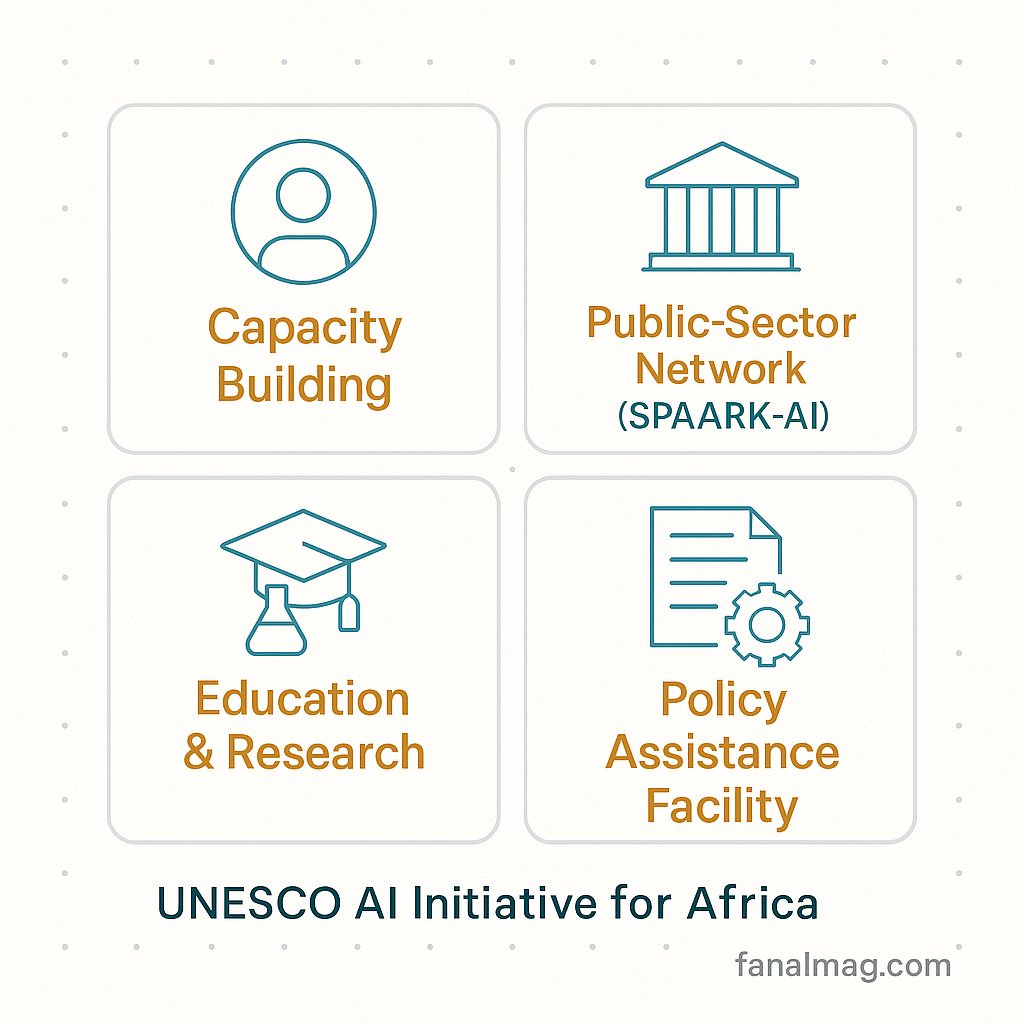
1. Capacity Building: Training for Civil Servants and Judicial Systems
The initiative prioritises equipping Africa’s public sector with the skills and knowledge needed to navigate AI’s opportunities and challenges. Key targets include:
- Training 15,000 civil servants: These professionals will gain expertise in AI applications, digital transformation, and associated risks such as bias, privacy violations, and cybersecurity threats.
- Training 5,000 judges and prosecutors: This specialised cohort will focus on understanding AI’s implications in legal contexts, including ethical considerations, data protection, and AI-driven judicial tools.
- Methodology: Training will be delivered through a combination of in-person workshops, online modules, and train-the-trainer models to ensure scalability and sustainability.
This capacity-building effort is designed to create a ripple effect, enabling trained individuals to share knowledge within their institutions and communities, fostering a culture of informed AI governance.
2. Public-Sector Network: SPAARK-AI Alliance
A cornerstone of the initiative is the SPAARK-AI Alliance (Schools of Public Administration for AI Readiness and Knowledge), launched in June 2025. This network connects public administration schools across 45 African states to standardise and scale AI training. The alliance will:
- Develop harmonised curricula tailored to African contexts, focusing on ethical AI use, governance frameworks, and risk mitigation.
- Facilitate knowledge sharing and best practices among member institutions.
- Serve as a platform for ongoing professional development, ensuring that public servants remain updated on evolving AI technologies and policies.
By leveraging this network, UNESCO aims to create a sustainable ecosystem for AI capacity building, reducing reliance on external expertise and fostering local ownership.
3. Education and Talent Development
Recognising the importance of education in building an AI-ready workforce, the initiative includes targeted programs for students, educators, and researchers:
- Training 2,000 teachers and students: This component focuses on integrating AI literacy into educational systems, equipping educators to teach AI concepts and preparing students for AI-driven economies.
- Briefing 30 education policymakers: These briefings will provide policymakers with insights into AI’s role in education, including curriculum development, digital inclusion, and equitable access to technology.
- Pan-African AI Incubator: A flagship program will support 1,500 researchers through a continent-wide incubator, fostering innovation and collaboration in AI research tailored to African challenges, such as healthcare, agriculture, and climate resilience.
These efforts aim to nurture a new generation of African AI talent while ensuring that educational systems are aligned with the continent’s digital transformation goals.
4. Policy Tool: Technology Policy Assistance Facility
To support the development of national AI strategies, UNESCO has introduced the Technology Policy Assistance Facility, a web-based platform launched in collaboration with the G20 and South Africa. This tool offers:
- Case studies: Real-world examples of successful AI governance models from Africa and beyond.
- Training modules: Interactive resources to guide policymakers in drafting AI policies that align with human rights and ethical principles.
- Expert directory: A network of AI policy experts available for consultation, ensuring that countries have access to specialised guidance.
The facility is designed to help African nations craft tailored AI roadmaps that balance innovation with safeguards for privacy, equity, and sovereignty. It builds on UNESCO’s Recommendation on the Ethics of AI, which has been adopted by 77 countries globally, including 29 in Africa, and translated into actionable policy frameworks.
Why It Matters
The UNESCO AI Initiative for Africa addresses a critical gap in the global AI landscape: the need for context-specific governance frameworks that reflect Africa’s diverse cultural, economic, and social realities.
By moving from high-level ethical principles to practical implementation, the initiative aligns with the African Union’s Continental AI Strategy (2024), which emphasises AI as a lever for economic growth, social inclusion, and technological sovereignty. Key reasons why this matters include:
- Bridging the capacity gap: Africa’s AI ecosystem is still developing, with uneven access to skills, infrastructure, and funding. The initiative’s training programs aim to address this by building a critical mass of AI-literate professionals.
- Promoting ethical AI: With risks such as algorithmic bias, data exploitation, and digital exclusion, the initiative prioritises human rights-aligned AI governance, ensuring that technology serves the public good.
- Enhancing sovereignty: By fostering local expertise and policy frameworks, the initiative empowers African nations to shape their AI futures, reducing dependence on foreign technologies and standards.
- Supporting sustainable development: AI applications in sectors like healthcare, agriculture, and education can address pressing challenges, from disease outbreaks to food security, provided they are governed responsibly.
As the Director-General Audrey Azoulay stated,
“Our goal is to spur endogenous momentum in Africa… training talent, adapting institutions, and responding to African priorities.”
UNESCO Director-General Audrey Azoulay
This vision underscores the initiative’s focus on empowering African stakeholders to lead their AI journey.
Context: Africa’s AI Landscape
Africa’s AI ecosystem is at a pivotal moment. The African Union’s Continental AI Strategy (2024) frames AI as a catalyst for achieving the Sustainable Development Goals (SDGs) and Agenda 2063, emphasising the need for inclusive, ethical, and locally driven AI development. However, challenges remain:
- Capacity constraints: Limited access to AI expertise and infrastructure hinders adoption. Learn more about Africa’s Data Centres.
- Coordination gaps: Fragmented efforts across countries and sectors slow progress.
- Risk mitigation: Concerns about data privacy, algorithmic bias, and digital divides require robust governance frameworks.
UNESCO’s initiative serves as a bridge between high-level aspirations and on-the-ground implementation, leveraging its global expertise in AI ethics and partnerships with African institutions.
Implementation and Partnerships
The AI Initiative for Africa is a collaborative effort involving multiple stakeholders:
- African Union: Provides strategic alignment with continental priorities and facilitates coordination among member states.
- South Africa’s G20 Presidency: Offers political and financial backing, ensuring the initiative’s visibility and resources.
- Local institutions, including universities, public administration schools, and civil society organisations, will play a key role in delivering training and shaping policies.
- Global partners: The G20 and other international bodies provide technical and financial support, particularly for the Technology Policy Assistance Facility.
Implementation will begin with pilot programs in select countries, followed by a continent-wide rollout. UNESCO will collaborate with governments to sign Memoranda of Understanding (MOUs), formalising commitments and securing funding for training and policy development.
What’s Next with UNESCO AI Initiative for Africa
The initiative is poised to make significant strides in the coming years. Key milestones to watch include:
- Country-level MOUs: Agreements between UNESCO and African governments to implement training programs and policy frameworks.
- Budget allocations: National budgets earmarked for AI training and infrastructure development.
- National AI roadmaps: The first batch of country-specific AI strategies, developed using the Technology Policy Assistance Facility, is expected to emerge by mid-2026.
- Monitoring and evaluation: UNESCO will track progress through key metrics, including the number of trained professionals, policies adopted, and research outputs from the pan-African incubator.
South Africa’s G20 communications confirm that the Technology Policy Assistance Facility is now live, marking a significant step toward operationalising the initiative.
Conclusion
UNESCO AI Initiative for Africa represents a bold and forward-thinking effort to position Africa as a leader in ethical AI adoption. By combining capacity building, innovative policy tools, and strategic partnerships, the initiative addresses the continent’s unique challenges and opportunities in the AI era.
As African nations begin to implement this roadmap, they will be better equipped to harness AI for sustainable development, ensuring that the technology serves as a force for inclusion, equity, and progress.