
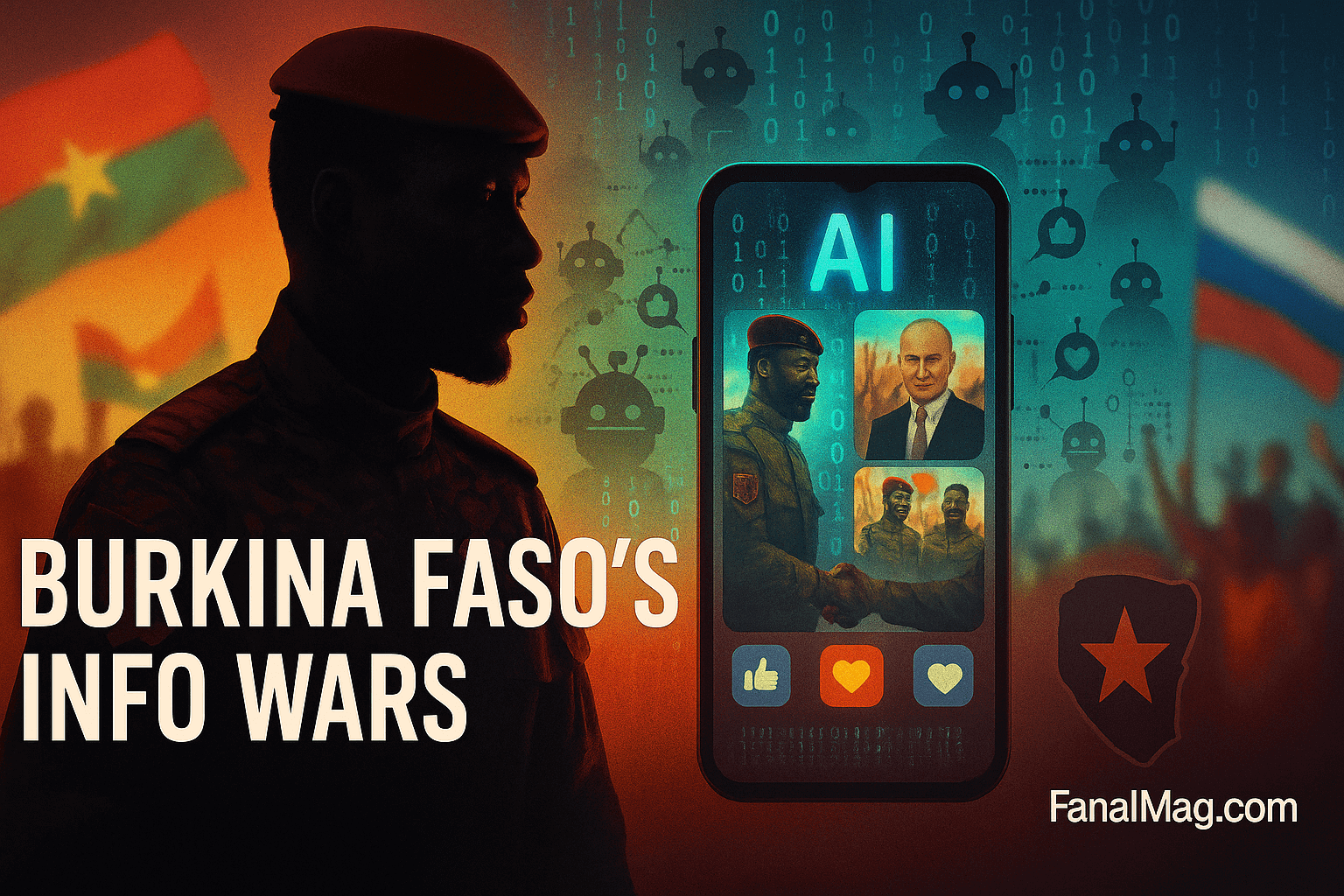

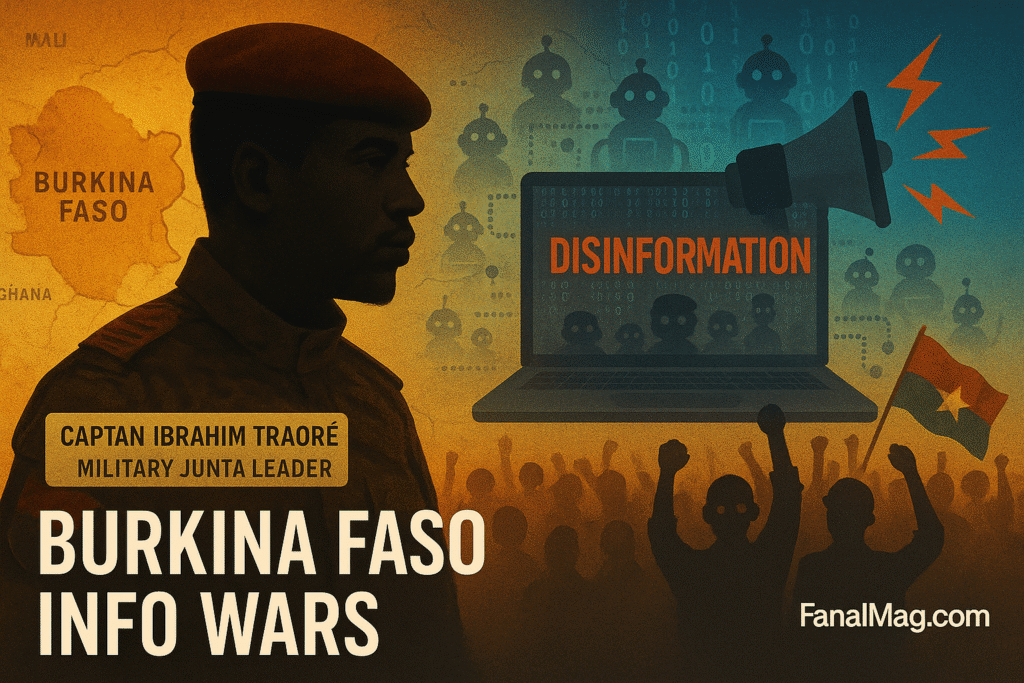
Burkina Faso AI misinformation is no sideshow; it’s the second front. A torrent of AI-generated imagery, coordinated social accounts, and “patriotic” news pages has elevated Captain Ibrahim Traoré into a pan-African folk hero online. At the same time, offline, the state dissolves institutions, arrests journalists, and detains aid workers on “spying” claims.
This isn’t ambient noise. It’s a strategy that shapes policy, loyalty, and risk on the ground, turning the timeline into a battlespace where deepfakes and bot swarms amplify hard power, and “information sovereignty” becomes both slogan and sorting algorithm for the public square.
How Burkina Faso AI misinformation is engineered
Over the last two years, Burkina Faso has become a showcase for modern influence ops: AI deepfakes, music anthems, and highly shareable edits that present Traoré as a fearless anti-colonial reformer embraced by global celebrities.
Investigations and media monitoring have traced the amplification to Russia-linked networks that evolved from Wagner playbooks into the rebranded “Africa Corps,” combining paramilitary support with content farms and proxy media. The goals are to validate the junta, discredit critics, and steer public opinion toward Moscow.
A February 2025 brief from the EU Institute for Security Studies (EUISS) quantifies the surge: between 2020 and 2023, a media-based proxy for Russian engagement in Burkina Faso jumped 940%.
Identified Russia-linked disinformation campaigns rose from one in 2022 to eight in 2024. Gallup polling shows approval of Russia’s leadership among Burkinabè increasing from 55% (2019) to 81% (2023)—while approval of France’s leadership fell to below 20%. Correlation isn’t causation, but EUISS finds an unusually tight coupling between Russia’s visibility and its approval in Burkina Faso’s infosphere. EUISS
Independent reporting documents how these narratives work: slick AI visuals depict Traoré with world leaders; unrelated footage from other countries is relabeled as Burkinabè successes or Western protests in his support. The aesthetic is aspirational, with an emotional payload of anti-colonial pride, and the distribution runs through Facebook, TikTok, Telegram, and X, as well as the Africa Defence Forum.
From propaganda to policy: Burkina Faso AI misinformation and the state
The online spectacle has been matched by hard policy. On July 17, 2025, the junta dissolved the independent electoral commission, shifting election management to the interior ministry and extending a transitional charter that allows Capt. Traoré to remain in power until July 2029. Officials framed the move as reducing costs and foreign influence. Critics called it the death of a key check in the system.
The government has also ordered state entities to withdraw from Western media subscriptions as part of an “information sovereignty” push—another signal that the state intends to curate inputs as aggressively as it curates outputs.
This sits atop a longer crackdown: by April 2024, Reporters Without Borders tallied 13 news sites blocked in Burkina Faso; in March–April 2025, Human Rights Watch and the OCCRP reported arrests and abductions of journalists who criticised the junta’s controls. HRW’s summary is blunt: repression has “spiked,” alongside abuses by security forces and pro-government militias.
The state has repeatedly constrained platforms when conditions tighten. Facebook has faced blocks since 2022 during unrest, according to network-measurement groups, and Africa-wide data show record internet shutdowns in 2024—a context in which Burkina Faso is a repeat offender. When you narrow the pipe, vetted narratives become the only water.
What the data says beyond Burkina Faso AI misinformation
The disinformation boom hasn’t delivered security. ACLED’s Sahel data and rights-group reporting paint a grim 2024–2025: jihadist violence persisted; both insurgents and pro-government forces killed civilians; and the government leaned on hastily mobilised auxiliaries, the Volunteers for the Defence of the Homeland (VDP), with mixed results and serious abuses.
Human Rights Watch cites ACLED estimates of 1,000+ civilians killed by the military and VDPs in just the first half of 2024; AP reporting in 2025 documented a massacre of at least 100 civilians near Solenzo amid a cycle of reprisals.
The violence overlaps with civic repression: in March 2025, three prominent journalists were arrested; in October 2025, the junta detained eight humanitarian workers on espionage allegations, claiming they recorded troop movements. INSO, the safety NGO involved, denies wrongdoing and says it collects information only to keep aid workers safe. The chilling effect is the point: fewer eyes mean fewer witnesses.
Why Burkina Faso AI misinformation matters for the Sahel
Burkina Faso is not alone; Mali and Niger run parallel playbooks, but EUISS data suggest the tightest lockstep between Russian media engagement and approval is in Burkina Faso.
That is rare in opinion research and indicates messaging is landing in an environment primed by three things: insecurity, anti-French sentiment, and a leadership that has made information control a governing instrument, not just a campaign tactic. EUISS
For platforms and policymakers, the lesson is less about “fake news” than information logistics. In a low-trust, low-infrastructure environment, cheap AI visuals and coordinated distribution can outperform traditional media—especially when the state shrinks independent outlets and occasionally throttles the internet.
The result is an attention monoculture where dissent struggles to germinate.
Burkina Faso AI misinformation: numbers to watch
- Engagement surge: Russia–Burkina media linkage up 940% (2020–2023); Russian disinfo campaigns identified: 8 (2024), up from 1 (2022).
- Opinion drift: Approval of Russia’s leadership: 55% → 81% (2019–2023); approval of France: down to <20%.
- Civic space: 13 media sites blocked (by April 2024); multiple journalist arrests/abductions in 2025.
- Conflict toll: 1,000+ civilians allegedly killed by state/auxiliaries in H1 2024; 100+ died in a single 2025 incident near Solenzo.
What Burkina Faso AI misinformation means for Africa’s media ecosystem
For African audiences, the Burkina Faso case is a stress test for the future of news in fragile states. AI lowers production costs to near zero; networked communities supply distribution; and geopolitics supplies the narrative scaffolding.
When audiences are angry at decades of stalled development and humiliations, real and perceived, “digital sovereignty” and “patriotic media” feel righteous. That moral fuel is why deepfakes and partisan edits travel farther and faster than careful reporting.
For neighbouring governments, the temptation is obvious: adopt the same doctrine. But the data cut both ways. Even as approval of Russia’s leadership rises, violence indicators remain stubborn. Influence operations can score opinion wins; they cannot fix governance or supply chains, and they do not build legitimacy that survives the first bad harvest.
What’s next in Burkina Faso AI misinformation
Three near-term indicators will signal whether the propaganda machine is entrenching or peaking:
- Institutional redesign: Monitor further revisions to the transition charter and electoral calendar, as well as any efforts to codify “information sovereignty” into law—particularly bans, licensing rules, or new offences related to “fake news.” The interior ministry’s new control over elections is a significant pivot point.
- Platform friction: Expect more periodic platform disruptions. Regional #KeepItOn data show shutdowns have become a normalised tool; any new unrest or military setbacks raise the probability of throttling.
- External Scaffolding: Monitor Russia’s Africa Corps footprint, state media partnerships, and local proxy outlets. If EUISS’s early-warning metric (media co-mentions with Russia) spikes again, treat it as a precursor to coordinated online (and sometimes offline) moves.
Burkina Faso’s information war is not a sideshow. It is the operating system for a regime that governs through security imperatives and narrative control. When citizens can’t easily verify claims—and when independent journalists and aid workers face detention for trying—the truth becomes contraband. The stakes, measured in both legitimacy and lives, keep rising.