
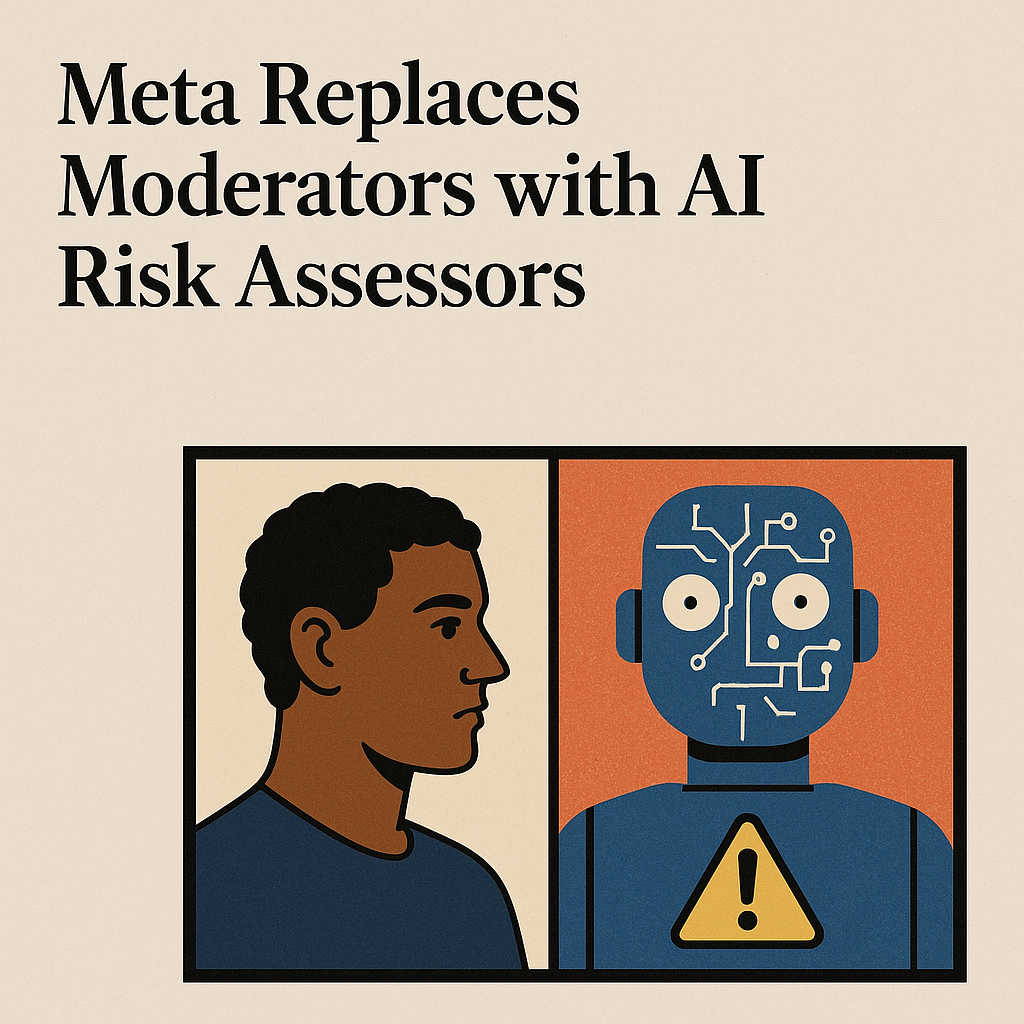

In a groundbreaking shift with global implications, Meta—the parent company of Facebook, Instagram, and Threads—has officially begun replacing large portions of its human content moderation workforce with AI-based “risk assessors.”
The announcement marks a pivotal moment in the tech giant’s long-standing battle against harmful content, misinformation, and hate speech.
While the move is being hailed internally as a leap toward efficiency, speed, and scalability, it’s also sparking serious concerns about accuracy, accountability, and the erosion of human judgment in online spaces.
🧠 What Are “AI Risk Assessors”?
Meta’s new system revolves around a suite of large language models (LLMs) and context-aware algorithms trained to evaluate posts, videos, and comments based on several parameters: policy compliance, virality risk, community impact, and context.
Unlike traditional moderation AIs that flag explicit rule violations, these new models operate more like “pre-crime scanners”—assessing whether a post might go viral in the wrong way or if it may pose a reputational risk to the platform before it even gains momentum.
A Meta engineer close to the development (speaking under anonymity) described the system as:
“A neural net that thinks like a moderator—but never sleeps, never panics, and doesn’t break under trauma.”
Meta Engineer (Anonymous)
⚙️ The Shift Away from Human Moderators
For years, Meta has relied on a global army of human content moderators—many of whom are located in the Philippines, Kenya, India, and Nigeria. These workers reviewed some of the darkest and most distressing content on the internet: graphic violence, abuse, extremist propaganda, and more.
Despite being essential to the company’s trust and safety ecosystem, these moderators have long suffered from underpayment, psychological trauma, and a lack of labour protection. In 2020, Facebook agreed to pay $52 million in a U.S. lawsuit over trauma suffered by moderators.
Now, Meta claims the new AI assessors will “lighten the load,” enabling faster detection and reducing human exposure to graphic material. But in practice, it also means massive job displacement across the Global South.
🗣️ Meta’s Official Statement
Lydia Cheng, Meta’s Head of Integrity Operations, said during the press briefing:
“AI risk assessors are part of our ongoing efforts to build a safer, faster, and more resilient online community. These systems can process millions of posts per second, detect coordinated attacks, and respond before harm occurs. They reduce reliance on human suffering to keep our platforms clean.”
Lydia Cheng (Meta’s Head of Intergrity Operations)
She added that humans will not be entirely removed. “Expert human reviewers will remain to manage appeals, guide policy updates, and review flagged edge cases.”
Still, insiders confirm that over 70% of Meta’s moderation workflows will soon be automated.
🌍 Africa’s Unique Vulnerability
Here’s where it gets genuine: Africa may suffer the most from this transition.
Meta platforms are lifelines across the continent—used for everything from business marketing to citizen activism, crisis reporting, and cultural dialogue. But African content is rich with slang, dialects, sarcasm, and sociopolitical subtext—much of which Meta’s AI has historically struggled to interpret.
Consider Nigerian Pidgin, where a phrase like “Wahala no dey but we go cause am small” may sound threatening but is typically used sarcastically or humorously. To AI trained predominantly on English-language Western datasets, this could be flagged as incitement or hate speech.
African languages and contexts are underrepresented in AI training sets, which means that false positives and wrongful takedowns are more likely.
💼 Job Losses in the Global South
Kenya, Nigeria, and South Africa have hosted thousands of human moderators over the years. These were not glamorous jobs, but they were jobs. And now they’re vanishing.
A Kenyan moderator who recently received notice of redundancy told FanalMag:
“We put our mental health on the line for years. We saw the worst of humanity every day. Now Meta says a robot is better—and that’s it. No retraining. No compensation.”
Labour advocates in Africa are demanding that Meta commit to upskilling or reabsorbing these workers into new AI audit or support roles. To date, no formal plans have been announced.
🧠 Does the AI Even Understand Us?
The big question is: can AI interpret cultural nuance, satire, or coded political speech?
In African nations where freedom of speech is already under pressure, content moderation is not just a technical issue—it’s a human rights concern. AI-based systems may struggle to distinguish between activism and extremism, religious metaphors and hate speech, or memes and misinformation.
According to Emmanuel Odunayo, a digital rights researcher in Lagos:
“This is how free speech dies—not by censorship, but by AI misunderstanding context. African voices will be silenced by algorithms that don’t even speak our language.”
Emmanuel Odunayo
🔄 Appeals and Accountability
Meta insists that flagged users will still be able to appeal AI decisions—but let’s be honest: navigating those systems is already hellish, and most users—especially in low-bandwidth areas—don’t stand a chance. And without transparent AI logs, who do you blame when the system makes a mistake?
One digital literacy group in Ghana is advocating for an AI Content Bill of Rights, calling for transparency, cultural training, and human oversight in every region.
🧭 The Bigger Picture: Automation of Moderation Across Big Tech
Meta isn’t alone. TikTok, YouTube, and X (formerly Twitter) are all following suit, using AI to handle the increasing moderation loads. Generative AI has made it easier to process text, audio, and video in real-time, making humans “redundant” from a business perspective.
But here’s the kicker: as we let black-box systems decide what’s harmful, we’re also letting them determine what stays public and what gets erased.
🚨 Final Thoughts: Faster Isn’t Always Smarter
AI risk assessors may help Meta move faster. But at what cost?
They may remove explicit harm but miss nuanced hate. They may speed up moderation, but this can also lead to wrongful bans. And most crucially, they may erase marginalised voices who don’t speak the algorithm’s language.
For Africa and other underrepresented regions, the AI moderation revolution could either be a tool for safety—or a digital colonizer in disguise.